
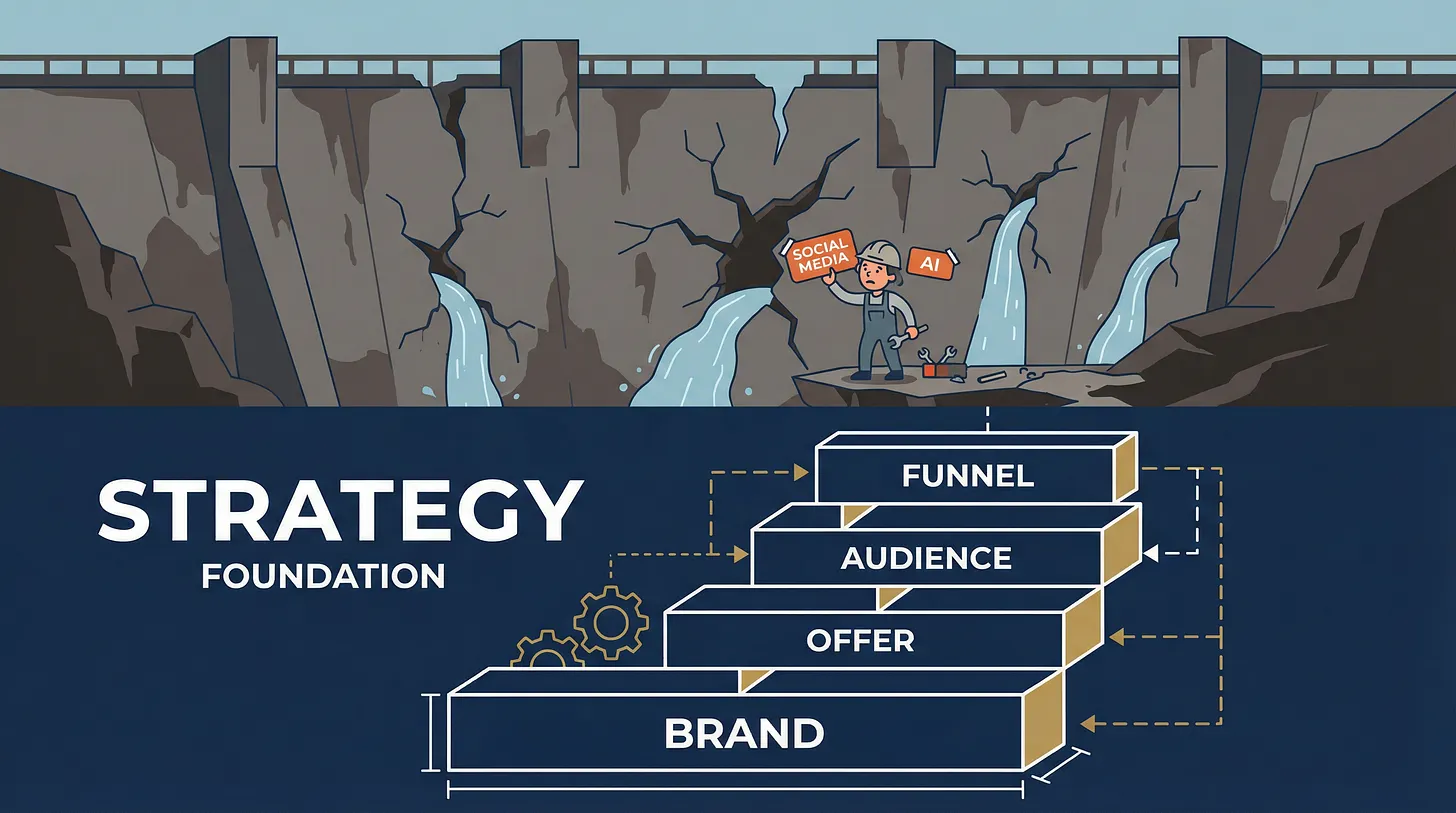
– Why “Cheap Marketing” Becomes Very Expensive
If you are reading this, chances are the situation will sound familiar.
Revenue is stagnating. The market is getting tougher, budgets are tight, management is nervous. At some point in a meeting someone says:
“We urgently need to do more on social media.”
Or, more recently:
“We should really start using AI, otherwise we’ll fall behind.”
Under pressure, it usually plays out like this:
A working student, maybe someone from customer service and ChatGPT are told to “try TikTok”, “post regularly” and “generate leads”.
On paper that sounds efficient.
In reality, it is often the opposite.
This article is written for the people who make those decisions. Not to point fingers, but to show why this pattern does not work – and what you actually need if you want marketing to contribute real growth.
At the end, I will outline a model I use in my work as an Fractional CMO: a lean, virtual team that operates like a serious agency, but with strategic ownership and without the overhead.
The same wave over and over: Social, funnels, AI – and whatever comes next
Marketing always has a new hype.
A few years ago it was Facebook pages, then funnels, then TikTok, now it is AI. Next year it will be something else.
The forms change, the pattern doesn’t:
- A new channel or tool is presented as the key to growth.
- Companies jump on it without looking at their foundations.
- After a few months, everyone is disappointed: lots of effort, little effect.
Not because social media, funnels or AI are useless.
They can be powerful. But they land on structures that are not ready for them.
If
- your positioning is unclear,
- your offer is not well defined,
- your sales process is full of gaps,
- no one really owns marketing end-to-end,
then a new channel does exactly one thing: it amplifies the confusion.
A TikTok account without a strategy is just another construction site.
AI without a strategy produces generic content faster.
A lead tool without a strategy only generates more leads that nobody can work with.
The illusion of “cheap marketing”
A sentence I hear again and again:
“A student can do that, they know social media. And we have ChatGPT now anyway.”
What that really means is:
We take a complex, business-critical function and push it into the smallest possible budget – and then hope it magically works.
Of course there are young people who do excellent work. And of course AI can be a massive lever. But both only work if the frame is solid:
- clear strategic decisions,
- understandable goals and priorities,
- defined target audiences and journeys,
- an offer that actually delivers value.
If that frame is missing, you usually end up with:
- content that looks fine, but doesn’t move numbers,
- text that sounds polished, but could belong to any competitor,
- campaigns that run, but never really reach sales,
- and a management team that concludes: “We tried, marketing just doesn’t work for us.”
The problem is not social media.
The problem is the setup.
“Cheap” can work when you buy printer paper.
In marketing, cheap is often the most expensive decision you can make, because you lose the only things you cannot recover: time, trust and opportunities.
The “200 leads in 6 weeks” promise – and what is usually missing
Parallel to this, another market is flourishing: agencies and freelancers with aggressive claims.
You have probably seen them:
“We will get you 200 leads in 6 weeks.”
“We guarantee you X booked calls per month.”
In a difficult market, that sounds tempting.
What almost nobody talks about are three basic questions:
- What exactly is a “lead”?
An email address? A PDF download? A webinar sign-up? A half-filled form?
Without a clear definition, the number means very little. - How qualified are these leads?
Are they even in your target segment?
Do they have real intent – or did they just enter their details for a giveaway? - What happens after the lead?
Is there a process that turns leads into customers?
Is there capacity in sales? Is there a thoughtful follow-up? Are your offers ready?
If nobody asks these questions, you are not buying value.
You are buying a number.
You end up with 200 records in a CRM, but:
- Sales is frustrated and ignores them,
- conversion rates are miserable,
- trust in “marketing” as a whole sinks even further.
Marketing that is optimised only for fast lead numbers is like a painkiller:
It suppresses a symptom for a short time, while the real issue remains unchanged.
What is actually missing: strategy, structure, expertise
Looking across cases, the pattern is surprisingly consistent.
Most companies do not lack ideas, tools or channels. They lack three things:
1. A clear strategy that is actually lived
Not a 70-slide deck, but real decisions:
- What do we stand for in this market?
- Whom do we want to attract – and whom not?
- What exactly should marketing achieve in the next 6–12 months?
“More visibility” is not a strategy.
“+20% revenue from existing customers through better retention and cross-sell” is a direction you can design content and campaigns around.
2. Structure and ownership
Who is truly responsible for:
- setting priorities,
- deciding what not to do,
- aligning marketing with sales, product and leadership,
- and holding the line when the next shiny object pops up?
As long as marketing is “everyone’s side job”, it is in reality nobody’s job. Then the market, the algorithm or the agency is to blame – never the structure.
3. Real expertise – not just “usage”
Social media, paid ads, content, email marketing, tracking, automation: each of these is its own discipline.
Expecting a junior marketer or a working student to master all of them at a senior level is unrealistic. Expecting AI to magically replace that expertise is risky.
What you actually need is:
- someone who sees the whole picture,
- who knows where depth is critical,
- and who can bring in the right specialists instead of trying to be one.
This is where an external CMO with a virtual team becomes interesting.
The Fractional CMO model: senior strategy without full-time overhead
Many mid-sized companies sit in a dilemma:
- A full-time senior marketing director is a big fixed cost.
- An agency covers a lot of ground, but often thinks in campaigns and media spend first – not in business models and lifetime value.
- An internal team without senior leadership stays tactical and firefights instead of building a system.
An fractional CMO model bridges exactly that gap.
It typically rests on three pillars:
1. Strategic ownership at C-level – part-time
An external CMO looks at your world from business goals down, not from channels up.
Typical responsibilities:
- analysing your starting point (numbers, funnel, positioning),
- sharpening the offer and customer segments,
- defining clear goals and KPIs,
- building a content and campaign architecture that fits your funnel,
- leading regular reviews and strategic adjustments.
You are not buying “a freelancer for some tasks”.
You are buying shared responsibility for direction and results.
2. A virtual specialist team instead of a “one-size-fits-all” solution
Instead of hoping that one person can “do it all” – or handing everything to an agency that internally still splits it to juniors – you assemble a lean team around your needs:
- performance marketer for Meta / Google / LinkedIn,
- content and copy for website, ads, email,
- design and video production,
- technical support for tracking, CRM and automation.
The difference:
This team does not run in separate silos. It is orchestrated – strategically – by the CMO.
The question is no longer: “Who has time for this?”
The question becomes: “What is the right skill set for this specific job?”
3. An agile setup that follows your business, not the other way around
You can scale intensity up or down:
- In growth phases, you ramp up campaigns, tests and production.
- In consolidation phases, the focus shifts to optimisation, retention and margin.
You do not carry the fixed cost of a full internal C-level plus team and an external agency.
You invest in a combination designed around impact, not headcount.
What changes for companies that switch to this logic
What does it look like day to day when an external CMO model is implemented seriously?
- There is a clear marketing roadmap for the next quarter and the next 12 months.
Not a list of activities, but a sequence of strategic moves. - Campaigns are anchored in the funnel.
Every measure is clearly assigned: Awareness, Consideration or Conversion – and evaluated accordingly. - AI has a defined place.
It speeds up research, ideation and drafting, but it does not make final decisions and does not replace strategy or senior review. - “Too-good-to-be-true” offers are easier to reject.
Because there is someone who has seen these cycles before and can evaluate them against your goals and setup. - Your internal team gets stronger.
People do not just execute tickets; they understand why something is done and how it fits the larger system.
In short:
Marketing shifts from “cost center that we cut when things are tight” to a structured engine that creates measurable value – and that you can explain to yourself at any time.
Questions worth asking yourself
If parts of this sound uncomfortably familiar, it might be worth sitting with a few questions:
- Are we currently trying to fix structural issues by adding a new channel?
- Do we actually have a decided strategy, or just a strategy document?
- Would we honestly recommend our current setup to a friend’s company?
- Are we spending more energy on “cheap fixes” than on building something robust?
If your honest answer is closer to “yes” than “no”, then your next move is probably not another platform, another intern or another AI hack.
It is to put strategy, structure and responsibility back at the center – and then decide which channels and tools you really need.
That is exactly the moment where an fractional CMO model starts to make sense – not as the next shiny object, but as a way to make sure the next wave, whether it is AI, the next social platform or something entirely different, doesn’t roll over you but is absorbed by a system that is built to handle it.
This article reflects how I think about marketing as one connected system. Read more about my approach →
Looking for marketing leadership that creates clarity?
I work as a Fractional CMO and marketing strategist with B2B SaaS, e-commerce and growth-stage companies across DACH and the Nordics. A 30-minute strategy call is usually enough to identify where the biggest opportunities are.
Book a Strategy Call →