
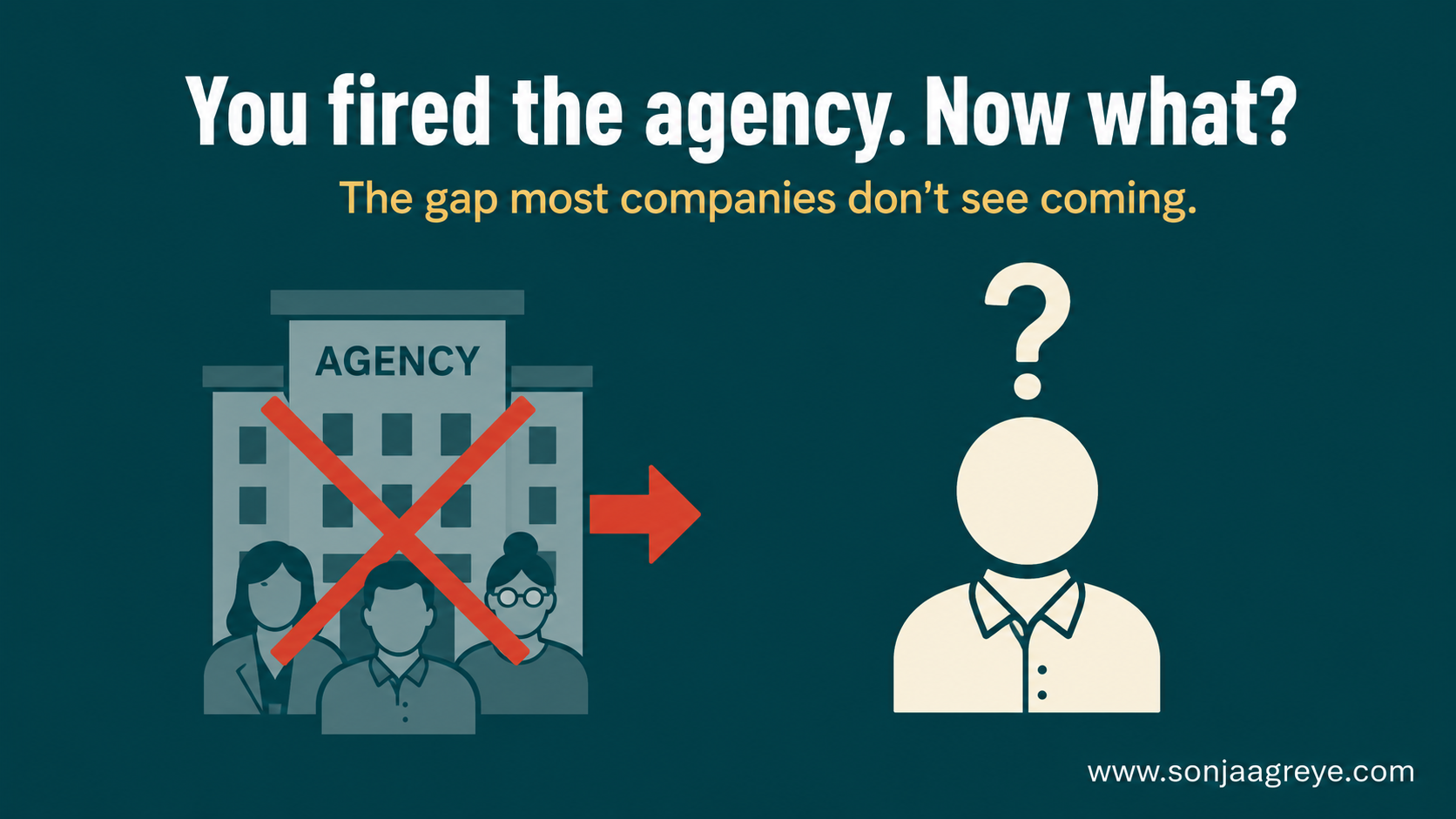
At some point, most growing companies have the same conversation.
The agency has been running for twelve, eighteen, maybe twenty-four months. The reports keep coming. The activities keep happening. And yet the leadership team cannot clearly explain what the marketing spend is actually producing. Leads are murky. Attribution is unclear. The account manager has changed twice. Every quarter the agency recommends a new service tier that will finally unlock the results everyone has been waiting for.
The decision to exit that relationship is usually the right one.
What happens next is where most companies make a second, quieter mistake.
Why the Agency Model Breaks Down at a Certain Stage
Agencies are built for execution at scale. They have teams, processes, and tooling optimised to deliver specific channel outputs efficiently. When a company is early and does not yet have internal marketing capability, that arrangement makes sense. You pay for access to skills you do not have internally, and you get something produced.
The model starts to break down when a company grows past the point where channel activity is the constraint.
At some scale, the problem is no longer that content is not being published or that ads are not running. The problem is that nobody can explain which content is moving customers through the funnel, which campaigns are producing pipeline versus vanity metrics, or how marketing connects to the revenue number the CEO is being held to.
Agencies are not built to answer those questions. They are built to produce deliverables and report on channel performance. The strategy, the priorities, the connection between marketing activity and business outcomes: those typically sit outside the scope of what an agency is contracted to own.
This is not a criticism of agencies. It is a description of what they are. The mismatch happens when companies expect strategic leadership from a relationship that was designed to deliver execution.
The Exit Is Usually the Right Call
When a company decides to pull back agency budget and bring things closer to home, the instinct is usually sound.
The overhead is real. Agency retainers for meaningful scope in DACH markets often run between €3,000 and €15,000 per month. For that investment, what you typically receive is managed activity in one or two channels, a monthly report, and a strategic layer that exists mainly in sales calls and onboarding documents.
The desire to build internal capability, to have someone who actually understands your product, your customers, and your market context working on your marketing every day, is not nostalgia for a simpler time. It reflects a genuine organisational need that agencies structurally cannot meet.
So the exit decision is often correct. What gets underestimated is what the exit leaves behind.
The Gap That Appears When the Agency Leaves
Here is what I see consistently, both in client engagements and in the professional development programmes where I teach digital marketing and AI tools.
The people companies build internally after an agency exit are often capable. They can run campaigns, manage content calendars, set up automations, work with the CRM, and produce reporting. The training programmes exist, the tools are accessible, and motivated people can develop genuine channel expertise relatively quickly.
What they cannot do, and what no amount of tactical training produces, is own the strategic direction.
Strategic ownership means deciding which channels deserve budget in the first place. It means setting priorities when resources are limited and everything feels urgent. It means translating what the board is asking for into a marketing plan that the team can actually execute. It means knowing when the funnel data is telling you to change course and having the authority to make that call.
That is not a skill gap. It is a role gap. And filling it requires a different profile than the one most companies hire for when they bring marketing inhouse.
What I See in the Classroom
I teach digital marketing and AI tools in certified professional programmes across Germany. The people in those courses are motivated, often mid-career, and learning quickly.
Many of them will go on to run marketing execution very well. They understand the platforms, they are building genuine competence in paid media, content, and automation, and they are thoughtful about how AI tools fit into their workflows.
What the training does not give them, and what no course can really give them, is the experience of having owned a marketing function strategically. Of having sat in the leadership meeting and argued for a budget reallocation. Of having built a reporting structure from scratch that actually influenced decisions. Of having made a positioning call that turned out to be wrong and then corrected it.
That experience comes from years of doing it, at companies where the stakes were real and the accountability was clear.
When a company exits an agency and replaces it with a skilled but junior internal hire, what they have done is solve the execution problem while leaving the strategy problem untouched. Often without realising it.
The Role That Actually Closes the Gap
In a previous article I wrote about what I called the operator gap: the missing profile in many B2B SaaS companies who is neither a campaign manager nor a full CMO, but someone who can hold the system together, coordinate specialists, and make the funnel run as a coherent whole.
That profile matters enormously in the post-agency context. A capable internal marketer is most valuable when they have clear direction, defined priorities, and someone senior enough to coordinate their work with sales, product, and the CEO.
Without that layer, even a talented internal hire ends up filling the gap themselves, making strategic calls they are not positioned to make, coordinating stakeholders without the authority to do so, and reporting to leadership in a language that does not connect to the numbers leadership actually cares about.
The agency was doing some version of this, imperfectly and expensively. When it leaves, the question is not just “who executes” but “who leads.”
Where a Fractional CMO Fits
A Fractional CMO is not a replacement for your internal marketer. It is the layer above them that makes their work produce results.
In the post-agency structure, the Fractional CMO owns the strategic direction, sets the priorities, translates business goals into a marketing plan, and coordinates across internal team members, remaining specialists, and the CEO. The internal hire executes within that structure. The combination is often more effective and less expensive than the agency arrangement it replaced.
The fractional model works here for a specific reason: the strategic leadership function does not require five days a week. Setting direction, reviewing what is working, making course corrections, managing the external relationships, and reporting to leadership might genuinely be eight to twelve days of senior time per month. Paying for a full-time CMO to fill that role is wasteful at most company stages. Leaving it empty is more expensive than it looks.
The companies that navigate the agency exit well are the ones that recognise what they are actually replacing. Not the deliverables. The judgment.
A Framework for Making the Decision
If you are considering or have recently completed an agency exit, three questions clarify where you actually stand.
Who is setting the marketing priorities right now? If the answer is the founder, an internal coordinator who inherited the role, or nobody in particular, the strategy gap is open. Activity will continue, but coherence will drift.
Can your internal team explain how their work connects to revenue? Not in terms of impressions or leads generated, but in terms of pipeline influence, customer acquisition cost, and retention patterns. If the answer is no, the problem is not their skills. It is the absence of a framework they were never given.
What would change if you had a senior marketing leader in the room once a week? If the answer involves clarity on priorities, better coordination with sales, more confidence in budget decisions, and reporting that leadership actually acts on, you are describing a fractional CMO engagement.
The Smarter Version of Bringing Marketing Inhouse
Pulling budget from an underperforming agency is often the right first move. But the companies that do it well do not just redistribute the budget to internal execution. They use part of it to bring in the strategic layer that the agency was never really delivering anyway.
Internal capability for execution. Senior leadership for direction. A clear reporting structure that connects the two to business outcomes.
That is not a complicated model. It is just one that requires being honest about what the agency was actually providing, what it was not, and what the internal hire you are building around can and cannot own.
The gap between those two things is where the growth engine either runs or stalls.
This article reflects how I think about marketing as one connected system. Read more about my approach →
Looking for marketing leadership that creates clarity?
I work as a Fractional CMO and marketing strategist with B2B SaaS, e-commerce and growth-stage companies across DACH and the Nordics. A 30-minute strategy call is usually enough to identify where the biggest opportunities are.
Book a Strategy Call →