
Building a Connected Website
and Booking System
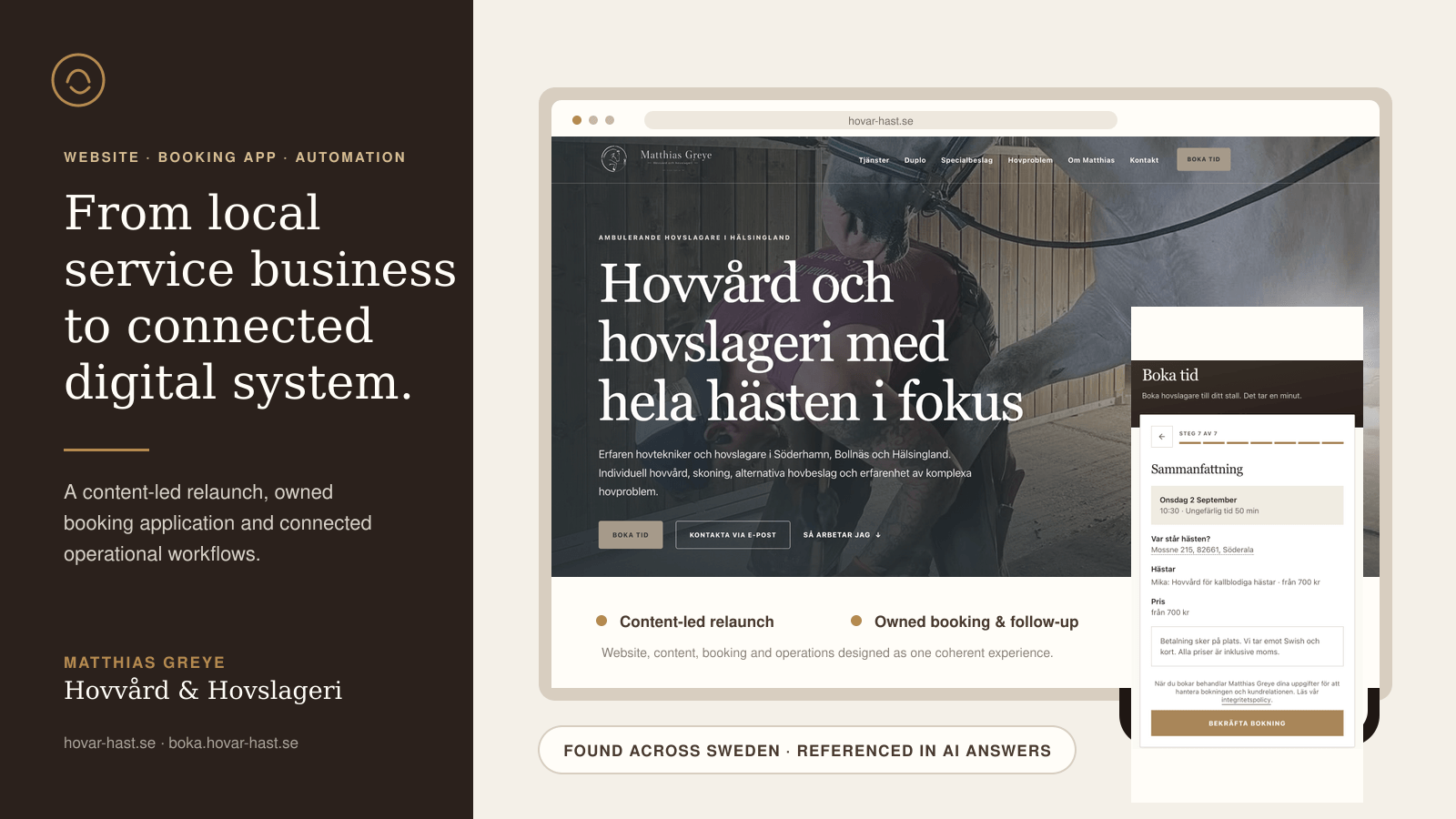
How I developed a coherent digital foundation for Matthias Greye · Hovvård & Hovslageri: a content-led website relaunch, a purpose-built booking application, connected customer and horse records, and automated communication.
The business needed more than
a visual update.
The existing setup kept the website, the booking process and day-to-day customer administration apart. That left Matthias with limited control over the customer experience and too little space to explain his approach, his specialist services and his work on hoof health. The project therefore started from a broader goal than improving a website: to build an owned digital environment that is clear and credible for customers and practical for Matthias in daily use.
For a mobile farrier business, a booking is more involved than picking an available slot. One appointment can cover several horses, different services with different durations, a stable address that differs from the billing address, travel between yards and an interval before the next visit. Matthias also needed a workable way to keep customer, horse and hoof-care records without private journal information ending up in an external marketing system.
Designing the customer journey
and the operating model together.
I treated the website, the booking flow and the internal administration as one service system rather than three projects. The work began with positioning and information architecture: what a customer needs to understand before booking, which services need additional explanation, and how trust is established for specialist hoof work where the buyer is often worried about a specific problem.
I then translated the operational reality into a data and workflow model. Customers, horses, services, stable locations, appointments, hoof-care records and follow-up dates needed clear relationships to each other. That allowed the public journey and the administrative workflow to draw on the same source of truth, while communication around each appointment runs automatically and remains controlled.
Positioning and content structure
A scalable architecture built around real customer questions, specialist services and hoof health.
Swedish copy and UX
Written and structured for clarity, trust and booking intent rather than for volume.
Booking logic
Services, duration, availability, horses and locations modelled as they behave in practice.
Operational data model
Customers, horses, appointments, journals and images with clear relationships and access rules.
Automated communication
Confirmation, rescheduling, cancellation, reminder and follow-up flows triggered by the booking lifecycle.
Security and testing
Privacy decisions, access control and end-to-end testing across the connected system.
Content that explains the work
before the booking.
The relaunched site presents Matthias under the public identity Matthias Greye · Hovvård & Hovslageri and went live on 26 July 2026. Alongside the core service pages it carries deeper content on Duplo, specialist shoeing and common hoof problems, which is where most customers arrive with an actual question rather than a general interest.
That structure does two things at once. It gives a prospective customer enough context to judge whether Matthias is the right person for their horse, which matters more than price in specialist work. And it establishes a content foundation that can be extended systematically into a hub around hooves, hoof care and hoof health, rather than a fixed brochure that has to be rebuilt when the business develops.
A booking flow shaped by
how the work actually runs.
The booking application at boka.hovar-hast.se gives customers a branded Swedish self-service journey instead of a generic scheduling widget. Standard booking tools assume one customer, one service and one slot. A mobile farrier visit does not work that way, and forcing the business into that model would have pushed the complexity back onto Matthias.
A customer can add several horses to one visit, give stable and billing information separately, and later reschedule or cancel through a protected link. Service selection carries duration with it, so the calendar reflects the real length of a visit rather than a fixed block.
One place for appointments,
horses and hoof-care records.
The administrative interface brings appointments, customers, horses, services, locations, hoof-care journals, photographs and follow-up dates together in a single view. Lovable and Supabase form the operational source of truth, with authentication and row-level security controlling what is accessible.
The practical value is in the follow-up interval. Hoof care is recurring work, and the record of what was done last time, on which horse, with which observations, is what makes the next visit efficient. Keeping that alongside the appointment data, rather than in a separate notebook, is what turns the system into something used daily instead of something maintained reluctantly.
An ICS feed makes the schedule visible in the calendar Matthias already uses. This is a one-way feed, not a two-way synchronisation.
Automated where it helps,
separated where it matters.
GoHighLevel handles the communication triggered by the booking lifecycle: booking confirmations, rescheduling, cancellations, a reminder 24 hours before the appointment, follow-up prompts and internal notifications when a new booking arrives. None of it requires Matthias to write a message while standing in a stable.
The more consequential decision was what to leave out. Hoof-care journal notes and photographs stay inside the operational system and are never passed to the communication platform. A marketing automation tool is designed to hold contact data for marketing purposes, and clinical-style records of a customer's horses do not belong there. Separating the two was a deliberate architectural choice made at the start, not a restriction discovered later.
What the connected system
does day to day.
Visibility as a result,
not the brief.
Google Search Console, 8 June to 7 September 2026.
Search was an input into the content architecture rather than the objective of the project. The data still confirms that the structure works. A click-through rate of 12.6 percent at an average position of 15 indicates that the pages are understood and chosen when they appear, which is unusual at that position and points to titles and content that match what people are looking for.
The site is found for subject terms such as hovvård and hovvårdare as well as for regional farrier searches in parts of Sweden well outside the practical service area around Söderhamn, Bollnäs and Hälsingland. Google's report on AI features recorded 14 impressions for the site in the same property, which means the content is being drawn on in AI-generated results and not only in the classic listing. This is observed generative visibility at a point in time, not a guaranteed or permanent position.
A digital foundation built around
the real business.
The project created a coherent customer journey across discovery, evaluation, booking and follow-up. Customers can understand the offer and manage their appointment through a dedicated branded experience. Matthias has a single operational view of what a mobile hoof-care visit actually requires, and the routine communication around each appointment is triggered automatically.
What matters beyond the launch is ownership. The website, the booking application, the customer and horse data and the content structure all sit inside a system Matthias controls and can extend. The site can grow into a content hub for hoof care and hoof health without a rebuild, and the booking application can take on new services without changing how it works.
- The website and the custom booking domain are live.
- A real booking was created through the completed integration.
- The confirmation contained the correct date, time, horse, service, stable address and secure management link.
- The internal new-booking notification reached Matthias.
- Login, password recovery and secure appointment management were tested on the custom domain.
I led the project from positioning and content strategy through product design, implementation and testing. The work combined marketing strategy, information architecture, UX, copywriting, website development, booking-flow design, data modelling, automation, SEO and GEO, and quality assurance, and I coordinated the interfaces between WordPress, Lovable, Supabase and GoHighLevel.
Matthias Greye is my husband, and the project was carried out as a full engagement on that basis: the requirements, the constraints and the testing were treated exactly as they would be for any other client.
No before-and-after data on conversion rate, booking time or administrative hours has been recorded, so no such figures are claimed here.
The stack behind
the connected system.
Public website and content structure
Public booking journey and administrative application
PostgreSQL database, authentication, row-level security, server functions and storage
Event-driven email communication and internal notifications
One-way calendar feed for operational visibility
Marketing System Audit
If your website, customer journey and internal workflows are pulling in different directions, the Marketing System Audit identifies where the experience breaks and which part should be connected first. Diagnose the constraint before you scale it.