
There is a particular kind of frustration that does not have a clean name.
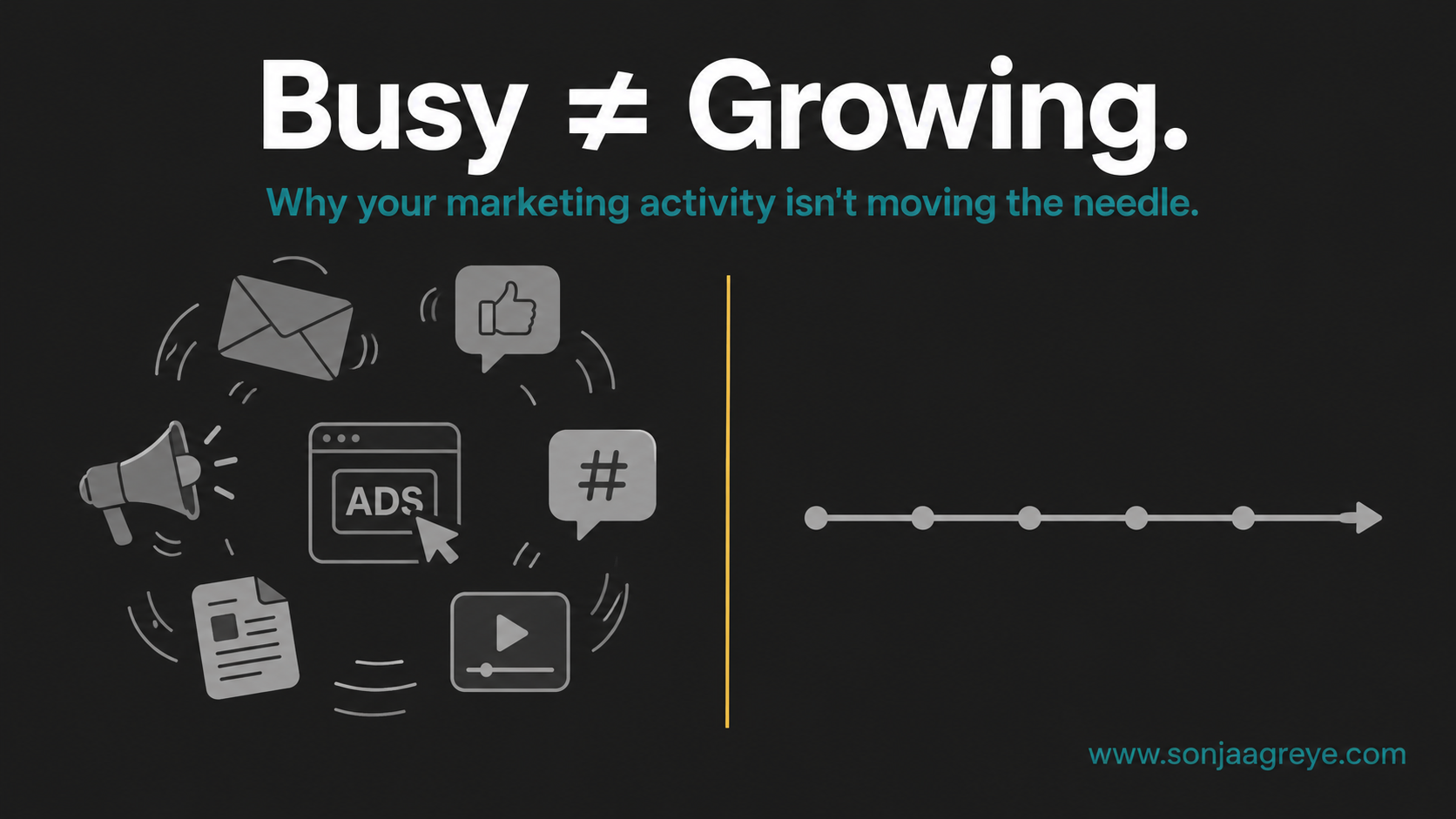
The team is working. Content is going out. The agency is sending reports. Ads are running. The CRM has activity in it. From the outside, and sometimes even from the inside, it looks like marketing is happening.
And yet the growth curve is not moving the way it should. Leads are inconsistent. The pipeline is lumpy. Some months are strong and nobody can fully explain why. Other months are quiet and nobody can explain that either.
This is one of the most common situations I encounter when I start working with a new company. And it is one of the hardest to articulate, because the evidence of a problem is mostly the absence of something rather than the presence of something obviously wrong.
Why This Is Hard to Diagnose From the Inside
When marketing is visibly broken, the path forward is relatively clear. Campaigns are failing. Leads have dried up. Something specific stopped working and needs to be fixed.
The situation I am describing is more disorienting because nothing is visibly broken. Everything is running. The problem is that running and working are not the same thing.
Running means activity is happening. Working means that activity is producing the outcomes the business needs, predictably and in a way that can be understood, adjusted, and scaled.
Most marketing functions, left without senior leadership, drift toward running. Not because the people involved are not capable, but because without strategic ownership at the top, the path of least resistance is to keep doing what was already being done. Produce the content. Run the campaigns. Send the reports. Stay busy.
The connection between that activity and actual business growth is assumed rather than designed. And assumptions about how marketing connects to revenue have a way of quietly failing for months before anyone names it.
The Four Patterns That Signal the Problem
In my experience, the “busy but flat” situation usually involves at least two of these four patterns.
Reporting that measures activity, not outcomes. The monthly report shows impressions, clicks, follower growth, and content pieces published. What it does not show is how many of those interactions became qualified leads, how many leads became customers, or what the cost of acquiring a new customer actually is. The reporting is real and the numbers are accurate. They are just not connected to the question the business actually needs answered.
Priorities set by whoever is loudest. In the absence of a clear strategic framework, marketing priorities tend to be set reactively. The CEO mentions a competitor’s content and suddenly that becomes the focus. A sales rep asks for a one-pager and it jumps to the top of the queue. A trade show comes up and the whole quarter shifts around it. Individual decisions might each be defensible. The cumulative effect is a marketing function without a coherent direction.
Channels running in parallel without a shared logic. SEO, paid search, social media, email, content, events: in many companies these operate as separate tracks managed by separate people or agencies, each with their own metrics and none of them connected to a unified view of the customer journey. The result is spending across multiple channels without a clear understanding of which ones are actually driving growth and in what combination.
The founder as the connective tissue. When there is no senior marketing leader in place, the founder often ends up holding the system together by default. Coordinating between the internal team and the agency. Explaining the product to the content writer. Bridging marketing and sales when leads are not converting. This is time the founder should not be spending, and it is also a signal that the marketing function lacks the internal leadership to run itself.
What Is Actually Missing
The instinct, when marketing feels busy but ineffective, is often to add something. A new channel. A new tool. A new agency specialising in the thing the current one does not do well. A new hire with a specific skill set.
Sometimes that is the right move. More often, the problem is not a resource gap. It is a clarity gap.
Clarity about which customers the marketing is actually trying to reach. Clarity about what those customers need to hear and where they need to hear it. Clarity about which activities are producing results and which are producing noise. Clarity about what success looks like and how it will be measured.
That clarity does not emerge from more activity. It requires someone to step back from the execution layer and ask the questions that the execution layer is not positioned to ask. Which direction are we going? Why these channels and not others? What does the data actually tell us about where customers come from? What is working and why?
Those are leadership questions. They require strategic ownership, not more skilled execution.
The Difference Between a Busy Marketing Function and a Working One
A working marketing function is not necessarily more active than a busy one. In many cases it is less active, because someone has made deliberate decisions about where to focus and what to stop doing.
What makes it work is coherence. The channels reinforce each other. The message is consistent. The priorities are set against business goals rather than inherited from the previous quarter. There is someone who understands the whole system, not just their piece of it, and who is accountable for the outcome.
That coherence does not happen by accident and it does not emerge from a well-staffed execution team alone. It is built by someone who has the experience to see the system, the authority to set priorities, and the accountability to own the results.
In B2B SaaS specifically, where buying cycles are long, deals involve multiple stakeholders, and the connection between marketing activity and closed revenue can take months to become visible, the absence of that senior layer is particularly costly. I have written previously about the operator gap that shows up in many companies at this stage: the missing role between campaign execution and executive strategy that makes the whole system run.
The busy-but-flat pattern is often what that gap looks like from the outside.
Why Adding More Execution Rarely Solves It
The reflex to solve a growth problem with more marketing activity is understandable. If the current level of activity is not producing results, perhaps more of it will.
This rarely works, for a straightforward reason. If the underlying direction is unclear, producing more content, running more campaigns, or expanding into more channels scales the noise alongside the signal. You spend more and the confusion compounds.
I see this dynamic clearly in the professional training programmes where I teach digital marketing. The students learn the platforms well. They can build campaigns, set up automations, manage social channels, and analyse data. What the training cannot give them is the judgment to decide which of those skills to apply, in what order, toward what goal. That judgment comes from having owned the outcome, which is a different kind of experience than having executed the task.
When a company hires an internal marketer after an agency exit and then wonders why the situation has not fundamentally changed, this is usually why. The execution capability improved. The strategic layer remained empty.
What Changes When Strategic Ownership Is in Place
The shift that senior marketing leadership produces is not primarily about new ideas or better campaigns. It is about the quality of the decisions that shape what gets done.
Which customer segment is the priority right now and why. Which channel is generating pipeline and which is generating activity that looks like pipeline. Where the funnel is losing people and what that actually means. How to talk to the board about marketing in terms they will act on rather than nod at.
These decisions happen in every company, with or without a senior marketing leader. The difference is in who makes them and with what frame of reference. Without senior leadership, they tend to be made by default, by committee, or by whoever has the most energy that week. With it, they are made deliberately, against a clear view of what the business needs and what the data shows.
The practical effect, in my experience, is not a sudden transformation. It is a gradual shift from reactive to proactive, from activity-driven to outcome-driven, from a function that reports what it did to one that can explain what it produced and why.
That shift is what makes growth predictable rather than lumpy. And it is almost always the missing variable when marketing feels busy but the growth curve does not respond.
Where to Start
If the pattern I have described here sounds familiar, the most useful first step is not a new tool or a new channel. It is an honest audit of what the current marketing activity is actually producing and who in the organisation is accountable for that outcome.
If the answer to the second question is unclear, that is the diagnosis.
A Fractional CMO engagement typically starts exactly here: mapping what is in place, understanding what is working and what is not, and building the strategic layer that turns a busy marketing function into one that actually drives growth.
The activity does not usually need to change dramatically. The direction does.
Sonja Greye is a Fractional CMO and marketing strategist working with B2B SaaS, e-commerce and growth-stage companies across DACH and the Nordics. She is based in Sweden and works in English and German.
This article reflects how I think about marketing as one connected system. Read more about my approach →
Looking for marketing leadership that creates clarity?
I work as a Fractional CMO and marketing strategist with B2B SaaS, e-commerce and growth-stage companies across DACH and the Nordics. A 30-minute strategy call is usually enough to identify where the biggest opportunities are.
Book a Strategy Call →