
The Problem With Most Content Plans
Most companies I work with already have a content plan. There is a calendar with Reels, Stories, newsletter slots, maybe a blog post scheduled for whenever someone finds the time. The plan looks organised on paper.
In practice it feels like busywork. Content goes out because it was scheduled, not because it serves a clear purpose. The team is busy, but the business is not growing from it.
The difference between a content plan and a content engine is not volume or frequency. It is structure. A content engine is designed from the inside out, starting with what the business actually needs and building outward to formats and channels. A content plan is usually designed from the outside in, starting with the calendar and working backwards.
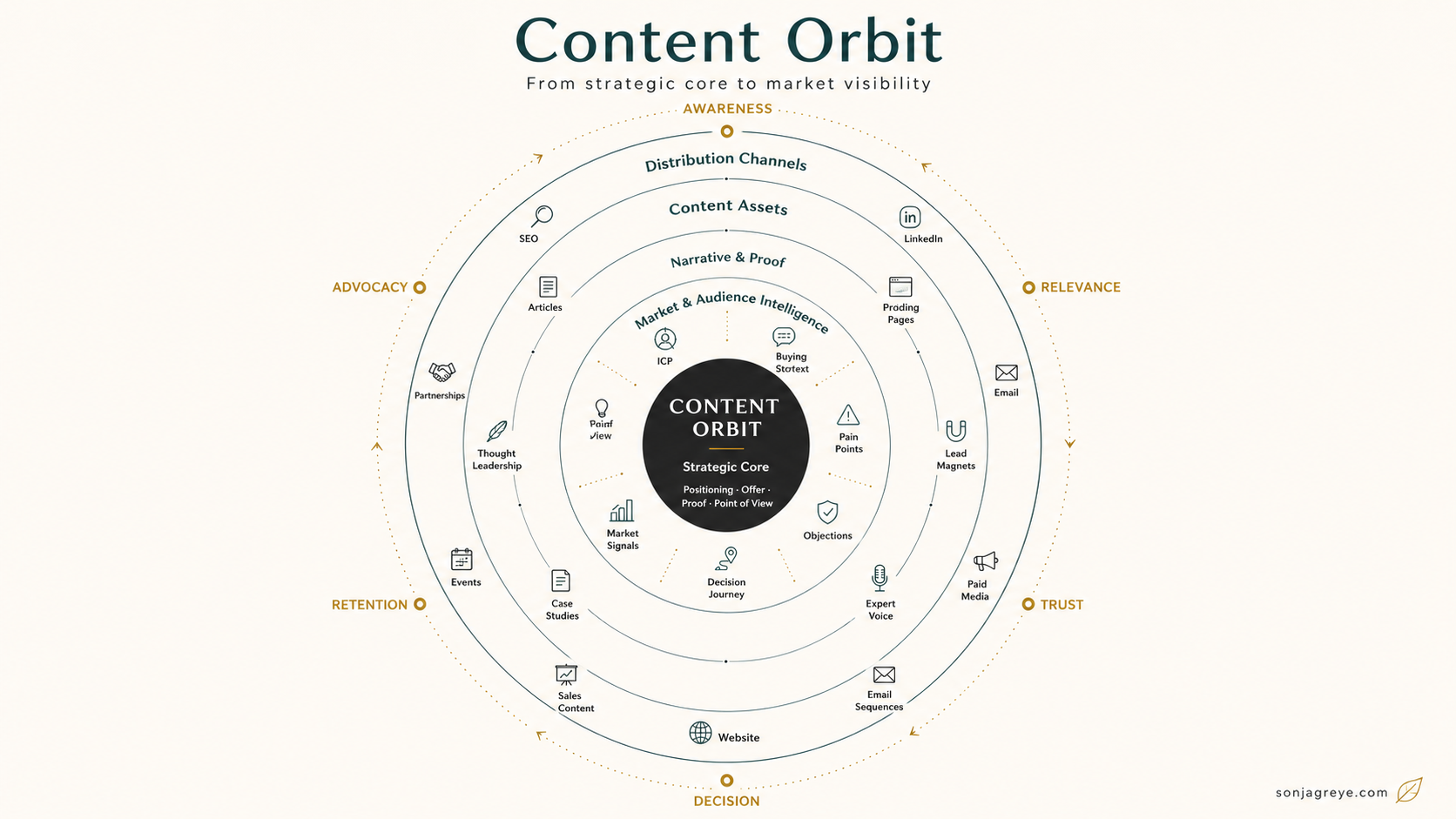
To show what the inside-out approach looks like in practice, I use a model I developed called the Content Orbit. Here is how it works.
The Content Orbit: A System Built Around the Brand Core
The Content Orbit is not a content calendar or a posting template. It is a way of thinking about content as a system with a clear centre of gravity.
Content is designed from the inside out across six layers:
1. Brand core — the decisions at the centre that filter every content idea.
2. Audiences and journey stages — specific situations, not demographic profiles.
3. Story lines — the recurring themes the brand owns in its market.
4. Voices and roles — who speaks for what, and why it matters.
5. Formats — how one core idea becomes multiple pieces of content.
6. Channels — where content lives, each with a defined function.
To make this concrete, here is how a fictional D2C skincare brand called Nordic Glow would work through each layer.
Layer 1: Brand Core — Decisions That Filter Everything
Before a single piece of content is produced, Nordic Glow needs clear answers to a few basic questions. What does the brand stand for beyond the product category? Which customers should feel directly addressed, and which ones intentionally not? What should content actually achieve in the next six to twelve months?
In a working session the team lands on this core statement: we help women with sensitive skin radically simplify their skincare routine, with a few well-tolerated products instead of overcrowded shelves.
That sentence is more than positioning copy. It is a filter. A trend post about the latest skin cycling hack probably does not fit. An honest guide explaining why three good products are enough for sensitive skin fits completely. A collaboration with an influencer who promotes a new serum every week does not align.
As long as the brand core is fuzzy, content will be inconsistent. With a sharp core, every content idea can be tested against the same question: does this reinforce the promise, or does it dilute it?
Layer 2: Audiences and Journey Stages
Traditional personas give names and demographics. For content strategy, what matters more is situations and journey stages.
For Nordic Glow, three typical entry points might be: a woman who has tried everything for years and is frustrated because her skin is not improving; a woman switching from conventional to clean skincare who feels overwhelmed by the options; and a long-term customer who is happy but needs a regular reason to reorder.
Each of these people moves through a different stage: discovering the brand, understanding the product, making a buying decision, using the product, and ideally becoming an advocate. Content that works in the discovery phase looks nothing like content that supports repurchase.
The Orbit forces a more precise question than most content planning processes ask: which content does an overwhelmed first-time visitor need in the discovery phase, and what does a satisfied existing customer need just before a repurchase decision?
Layer 3: Story Lines — Themes the Brand Owns
With brand core and journey stages clear, Nordic Glow deliberately chooses three recurring storylines and stays with them: less is more (why three good products outperform eight average ones), tolerance over trends (honest education about ingredients that irritate sensitive skin), and routines that last (how to build skincare habits that fit real life).
Staying with these themes changes how content feels to the audience. After a few months, people know what they come to Nordic Glow for. The brand becomes associated with specific ideas, not just products.
From one story line, you can derive an entire content chain. From less is more: a long-form guide explaining why sensitive skin needs fewer products, a short video showing what to leave off the shelf, a newsletter challenge around simplifying a routine, and a downloadable guide used as a lead magnet. Everything connects back to the same thread.
Layer 4: Voices and Roles
Many brands speak exclusively as the brand account. This quickly becomes flat. In the Content Orbit, Nordic Glow defines three distinct roles: the brand account for product facts and policies, the founder for story and point of view, and a skin expert for educational depth.
This changes the content immediately. A critical post about fragrance in skincare carries more weight when a real person with a name and background says it. A founder article explaining why the brand exists builds trust before someone makes a purchase. An expert answering questions turns an anonymous store into a guided experience.
Not every role needs to be active every day. What matters is knowing which voice is right for which topic and which situation.
Layer 5: Formats — One Idea, Multiple Pieces
Only at this stage does the question arise: what formats should we use? Instead of planning a blog post, a Reel and a newsletter as separate decisions, the Orbit encourages thinking in content chains.
One hero format, for example a comprehensive guide, becomes the source for multiple short-form pieces. A section of that guide on problematic ingredients becomes a short video, a newsletter example, an FAQ entry, and the basis for a dedicated product category page. One piece of strategic thinking produces multiple deliverables without starting from scratch each time.
Layer 6: Channels — Each With a Defined Function
Nordic Glow has accounts on several platforms but maintains only a fraction of them consistently. The Orbit assigns each active channel a specific function rather than treating them as interchangeable publishing slots.
Instagram and Reels for first contact and social proof. The website and blog for depth and SEO. The newsletter for relationship and repeat purchase. Paid ads for scalable reach at the discovery and decision stage. TikTok is intentionally not prioritised because the target audience is stronger on Instagram and resources are limited.
That last decision is the uncomfortable part. It feels wrong to ignore channels where competitors are active. Strategically, focusing is often the only way to build depth rather than constant surface-level activity across too many fronts.
What Changes When the Orbit Is in Place
Give this approach six to twelve months and the difference becomes visible. New content ideas are filtered against the Orbit rather than added by default. Planning happens in chains rather than isolated posts. Sales and support are integrated as content sources. Content is reused deliberately rather than reinvented constantly.
The brand starts to feel coherent across touchpoints. Search queries begin to reflect the language used in your content. Repeat purchase rates improve not because something went viral, but because content is doing its job systematically.
Whether you sell skincare, software, professional services or veterinary products, the principle holds. Content is effective when it is not just produced but built. The Content Orbit is the scaffolding for that.
This article reflects how I think about marketing as one connected system. Read more about my approach →
Looking for marketing leadership that creates clarity?
I work as a Fractional CMO and marketing strategist with B2B SaaS, e-commerce and growth-stage companies across DACH and the Nordics. A 30-minute strategy call is usually enough to identify where the biggest opportunities are.
Book a Strategy Call →