
There’s a sentence you hear surprisingly often in marketing discussions:
“Marketing isn’t fully measurable.”
It usually appears when marketing teams try to explain why certain activities don’t produce a clear ROI inside a Google Ads or Meta dashboard.
The problem is: the statement is largely incorrect.
Marketing is measurable. In fact, it’s often very measurable.
What’s frequently missing is not measurement, but the ability to translate marketing impact into the language of business performance.
Many marketing teams report platform metrics.
Executives, however, evaluate business outcomes.
Between those two worlds a gap emerges—and that gap is where marketing often loses strategic credibility.
When Marketing Gets Reduced to Media Buying
If marketing is evaluated primarily through advertising platforms like Google Ads or Meta Ads, it’s easy to assume that marketing is only measurable when a conversion can be directly attributed.
But that’s only one part of the picture.
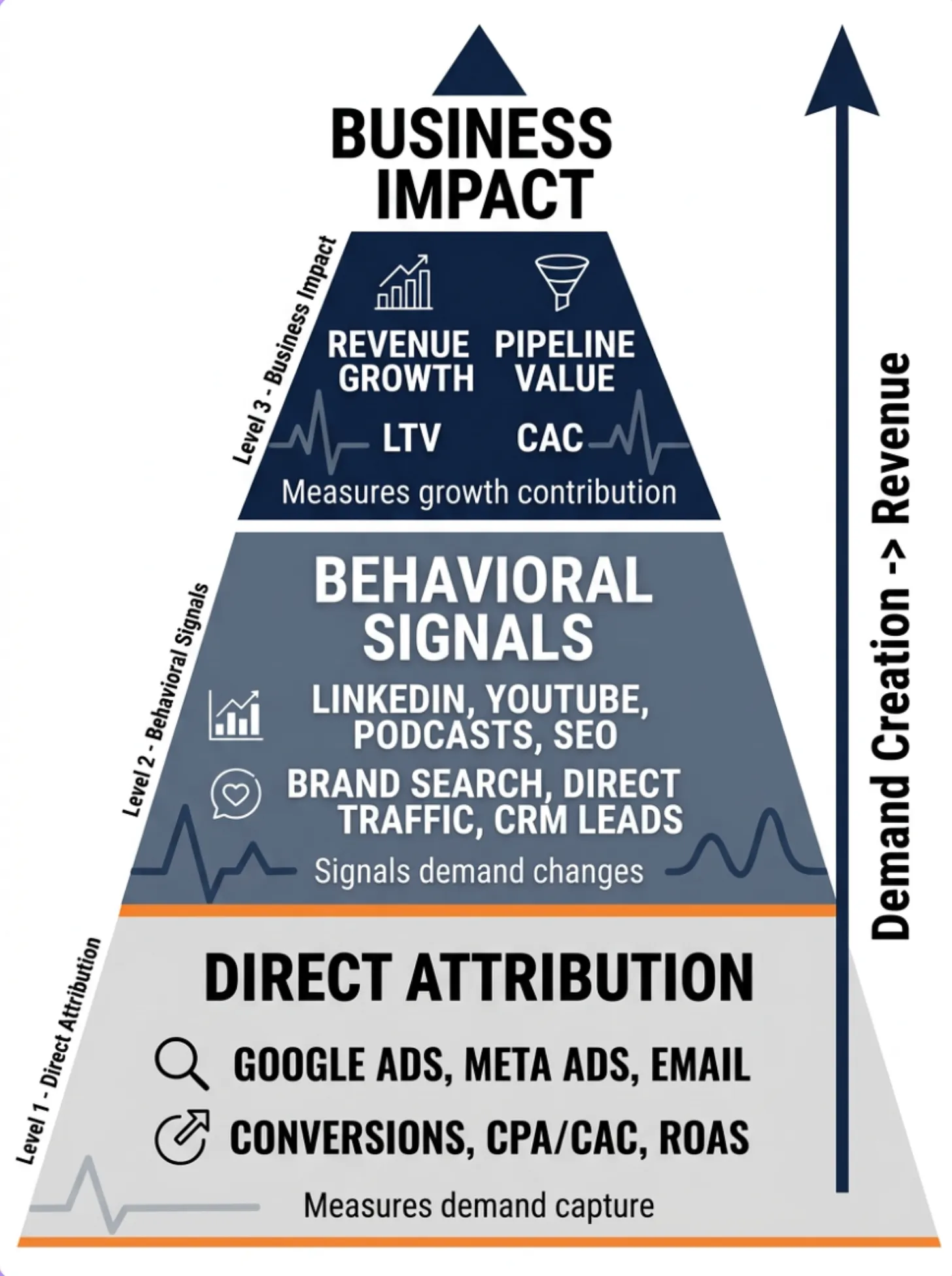
Channels like paid search or retargeting mostly operate in what is often called demand capture. They capture existing demand. Someone is already searching for a solution or demonstrating clear purchase intent.
In that context attribution works well:
click → conversion → revenue.
But demand capture does not create demand. It harvests it.
The larger part of marketing is about creating demand in the first place: building awareness, shaping perception, establishing trust and relevance in the market.
That part rarely works in a linear way, which is why it doesn’t show up neatly in a single dashboard.
But that does not make it unmeasurable.
Most Marketing Effects Are Indirectly Measurable
Anyone who seriously analyzes marketing performance quickly realizes that almost every channel leaves measurable signals behind. They simply don’t always appear where many teams first look.
Take social content or LinkedIn thought leadership as an example. A common argument is that these activities are difficult to measure because many users don’t click on links directly.
That’s true. But the impact shows up elsewhere.
When consistent content is published on LinkedIn over time, the data typically starts shifting in other places:
Brand searches increase.
Direct traffic grows.
Executive profile views rise.
Inbound inquiries appear in the CRM.
The conversion might later occur through Google search or direct website visits. In traditional attribution models the lead may therefore appear as “organic search” or “direct.”
But the trigger happened much earlier.
The same pattern appears with podcasts, long-form articles, conference appearances or educational YouTube content. People encounter a brand, remember it, and actively search for it later.
The demand is real. Attribution simply becomes more complex.
Why Attribution Has Become Harder
Part of this challenge is structural. The modern customer journey is fragmented across devices, platforms and time.
A first touchpoint may occur on a smartphone.
Research happens later on a laptop.
The purchase follows days or weeks afterward.
Another factor that is often underestimated is dark social.
A large share of digital content is now shared privately—through WhatsApp, Slack, Discord, internal company chats, or simple copy-and-paste links. Screenshots circulate. Recommendations happen in closed groups.
From the perspective of an analytics tool, these visits appear as direct traffic. The original source disappears.
New intermediaries like AI answer engines amplify this effect. When someone discovers a brand through an AI-generated recommendation and later searches for it manually, the original exposure is not transmitted as a referrer.
All of this makes user-level attribution more difficult.
But it does not eliminate measurable impact.
Measuring the System Instead of the Click
When marketing is analyzed as a system rather than a set of isolated channels, the signals become much clearer.
Brand search growth, for example, is one of the strongest indicators of increasing demand. When search volume for a brand steadily rises, something in the market is working.
Direct traffic is another signal that is often misunderstood. In many companies it is not random traffic—it reflects brand awareness, familiarity and repeat engagement.
CRM data provides additional context. When new leads consistently mention a podcast episode, an article, a LinkedIn post or a recommendation, qualitative signals begin to align with quantitative patterns.
More advanced organizations go further and use statistical methods like incrementality testing or marketing mix modeling. Instead of trying to attribute every single conversion perfectly, these models measure how marketing activities influence overall outcomes.
The central question changes.
Instead of asking:
“Which click caused the purchase?”
the better question becomes:
“How did marketing influence demand for our product?”
The Real Problem Is Reporting
So why does the myth of “unmeasurable marketing” persist?
In most cases the issue isn’t data.
It’s how marketing communicates its results.
Many marketing reports focus on platform metrics: impressions, clicks, engagement rates. Those numbers are operationally useful, but they rarely resonate with executives.
Leadership teams think in different terms: revenue growth, customer acquisition cost, pipeline value, market share.
When marketing speaks in platform metrics while the business evaluates financial outcomes, the two sides operate in different realities.
The result is predictable: marketing starts looking like a cost center rather than a growth driver.
Modern marketing leadership therefore has a crucial task: translating marketing activity into business impact.
Not just showing how many clicks a campaign generated, but how marketing contributes to demand creation, customer acquisition and long-term revenue.
Marketing Is Measurable, Just Not Always Linear
If marketing is judged solely through direct attribution, we mostly measure short-term effects.
But long-term growth rarely happens linearly. It emerges through repetition, trust and market presence. People rarely buy after the first exposure. They buy when a brand has become familiar enough to feel credible.
The challenge for marketing isn’t to prove that measurement is possible.
The challenge is to connect marketing signals to business outcomes in a meaningful way.
Marketing is not a single channel.
It is a system that shapes awareness, trust and demand in a market.
And those shifts can absolutely be measured as long as we are willing to look beyond the ad dashboard.
This article reflects how I think about marketing as one connected system. Read more about my approach →
Looking for marketing leadership that creates clarity?
I work as a Fractional CMO and marketing strategist with B2B SaaS, e-commerce and growth-stage companies across DACH and the Nordics. A 30-minute strategy call is usually enough to identify where the biggest opportunities are.
Book a Strategy Call →