
There is a quiet shift happening in how European companies structure marketing leadership. Not in the headlines, not in the trend reports yet, but in the actual conversations I have with founders and CEOs across DACH and the Nordics.
They are not looking for another agency. They are not ready to commit to a full-time CMO. What they are trying to articulate, often without the exact vocabulary, is something in between: senior marketing ownership, without the permanent overhead.
That is the fractional CMO model. And in Europe, it works differently than the American playbook suggests.
What Is a Fractional CMO, Actually?
A fractional CMO is an experienced marketing executive who works with a company on a part-time or flexible basis, owning the marketing strategy, leading the team, and reporting to the CEO or board, without being a full-time employee.
The word “fractional” refers to the time commitment, not the level of responsibility. A fractional CMO is not a consultant who delivers a deck and leaves. It is not a senior freelancer who executes one channel. The responsibility is executive-level: own the direction, build the structure, drive the outcomes.
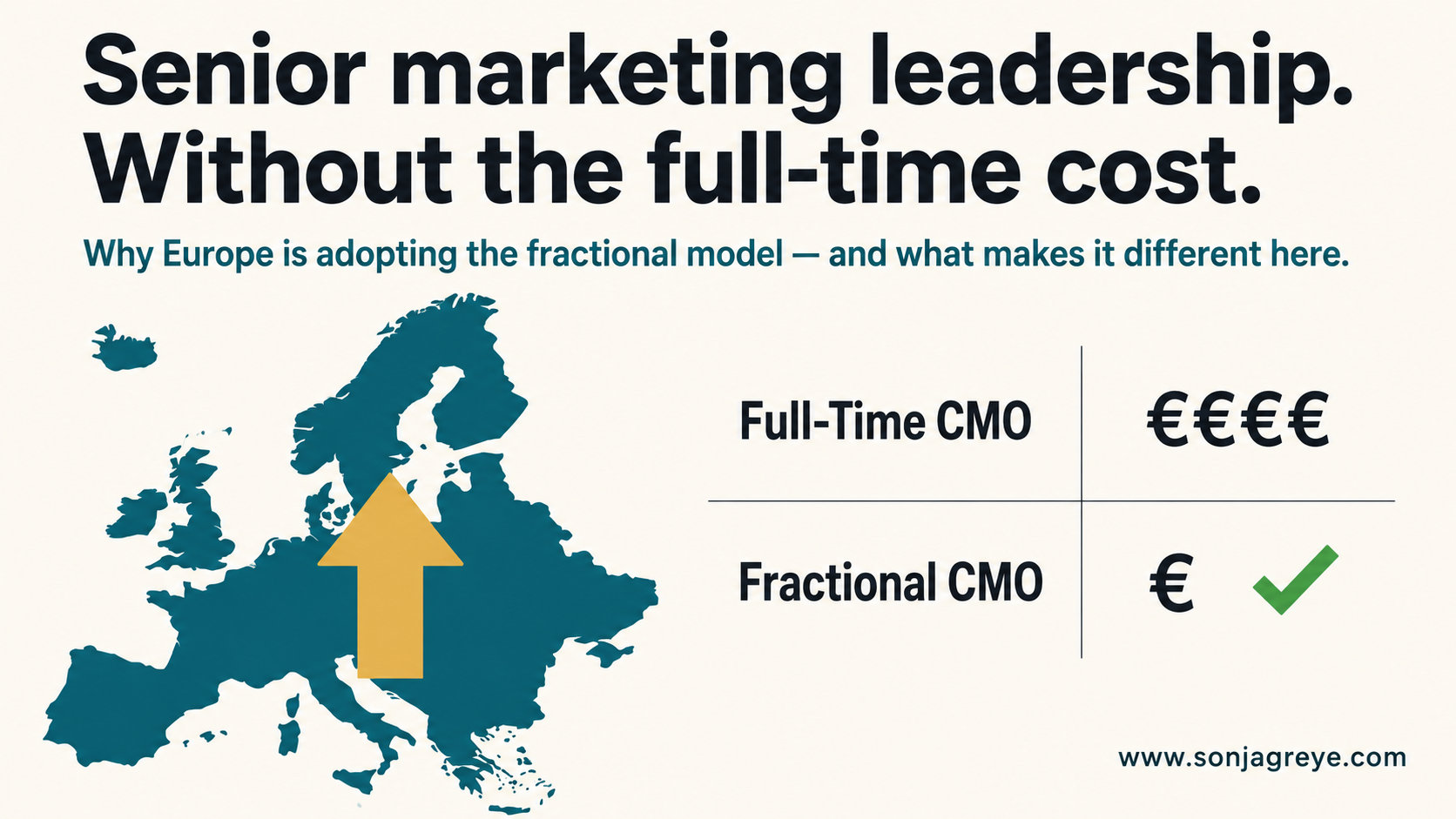
Where it differs from a full-time CMO is not in scope but in cost structure and commitment. You get C-suite strategic ownership without the €150,000 to €300,000 annual salary, without the equity package, without the six-month hiring process, and without the risk of the wrong hire sitting in a leadership seat for two years before anyone admits it.
For companies between roughly 10 and 200 employees, still building their marketing function or professionalising one that has grown without structure, this trade-off is often the most rational one available.
The Numbers Behind the Growth
This is not a niche trend. Between 2022 and 2024, the number of fractional marketing leaders globally grew from approximately 60,000 to 120,000 professionals, a doubling in two years. Mentions of “fractional leadership” on LinkedIn jumped from around 2,000 in 2022 to over 110,000 by early 2024.
By 2027, analysts estimate that over 30 percent of mid-sized companies will have at least one fractional executive on retainer.
In B2B SaaS specifically, a 2024 survey of 340 startup and SMB executives found that 9 percent were already working with a fractional CMO or planned to within 12 months. That was an 80 percent increase from the year before.
The model is accelerating. But the acceleration is not uniform across markets. And that matters if you are trying to understand what it actually looks like in a European context.
Why Europe Is a Structurally Different Market
Most of the content about fractional CMOs is written from a US perspective. American pricing, American hiring norms, American market dynamics. That framing fits poorly for companies in Germany, Sweden, the Netherlands, Switzerland, or Austria.
Here is what is actually different in Europe:
The contracting landscape is more complex. European employment law creates real constraints around independent contractor arrangements. In Germany, Scheinselbstständigkeit rules mean that what looks like a freelance engagement can be reclassified as employment, with significant liability for both parties. The Netherlands enforced its DBA legislation more strictly from January 2025. The UK has IR35. France has specific rules around portage salarial. A fractional CMO who has never navigated these frameworks is a liability, not an asset.
The business culture is more relationship-oriented. In DACH markets especially, trust is built before deals are made. B2B buying cycles are longer. Referral networks carry more weight than cold outbound. A marketing strategy built on US growth playbooks, aggressive volume outreach and fast transactional selling, often underperforms because it misreads how decisions are actually made. Senior marketing leadership in Europe needs to understand this at a structural level, not just adapt copy and translate landing pages.
The Mittelstand creates a specific leadership vacuum. Germany, Austria and Switzerland have thousands of mid-sized, often family-owned companies with strong products, deep industry knowledge, and marketing functions that have not kept pace with digital and AI transformation. These companies often have turnover between €5M and €100M, meaningful B2B customer relationships, and no marketing leader with strategic experience. They are exactly the profile for which the fractional model was built. And they are deeply underserved by both large agencies and the talent market for full-time CMOs.
The gap between available talent and budget is wider. A CMO with genuine B2B SaaS or e-commerce experience at a relevant scale in the DACH market commands a salary most growth-stage companies cannot justify. The fractional model closes that gap practically. You access the experience you need for the phase you are in, without locking into a cost structure designed for a company twice your size.
What Changes When There Is Real Marketing Leadership
The difference between a company with and without a marketing leader is not about output volume. It is about coherence.
Without senior ownership, marketing tends to be a collection of activities. Content goes out on schedule. Ads run. The CRM has leads in it. Reports get produced. But nobody can explain how the pieces connect, what the priorities are, or why growth is inconsistent.
When senior marketing leadership is in place, a different set of things becomes possible. Strategy is set against business goals, not channel benchmarks. Agencies and freelancers are coordinated rather than managed by a founder who should not be in that meeting. Budget decisions are made with data. There is someone in the leadership team who owns the number, understands the system, and can report on it in terms that the board actually cares about.
The fractional model delivers this. Not at reduced quality. At reduced cost and commitment, which for a company at the right stage is exactly what senior leadership looks like.
Fractional CMO vs. Full-Time CMO: The Real Cost Comparison
The base salary for a CMO in Germany averages around €111,000 in 2025. The total employment cost, once employer social contributions, bonuses, equipment, benefits, and onboarding are included, sits between €150,000 and €300,000 annually for most companies at this stage.
That number does not include the cost of a wrong hire. Recruiting, onboarding, and then exiting a senior leader who does not fit typically costs another six to twelve months of that salary before the situation is resolved.
A fractional engagement at serious scope typically runs between €2,000 and €8,000 per month depending on commitment and market. Annual cost at the higher end is still less than half of the all-in full-time equivalent. And the engagement can be structured, scoped, and ended without the legal and financial complexity of a permanent hire.
For companies that have not yet reached the scale where a full-time CMO salary is clearly justified, the arithmetic is straightforward.
The Leadership Dimension That Most Fractional Content Misses
There is something the standard fractional CMO content does not discuss, and it is the part I consider most important.
The value of senior marketing leadership is not primarily strategic. It is organisational. The strategy is often visible if you look carefully at your market, your customers, and your funnel data. What is harder is getting a team of people, agencies, and tools to execute it in the same direction, at pace, without constant intervention from the founder.
That requires leadership, not just strategy. It requires someone who can build alignment across different stakeholders, set priorities that people actually follow, and create the accountability structures that let execution happen reliably.
I came to marketing from a background as an officer in the German Armed Forces, leading teams in environments where clarity of direction and accountability for outcomes were not optional. That foundation shapes how I approach marketing leadership. Not with military rigidity, but with a clarity about what good coordination looks like, and what happens when it is absent.
The fractional model only delivers its full value when the person in the role can lead as well as strategise. A senior marketer who cannot build trust, manage internal conflict, or get a team to follow a direction is not a CMO. They are a very expensive consultant.
Who the Fractional Model Is Actually Built For
The profile that gets the most from a fractional CMO engagement is fairly specific.
It is a company with somewhere between 10 and 150 employees. Revenue between €1M and €20M, often with strong product-market fit but inconsistent growth. Marketing is happening, agencies are running, content is going out. But the founder is still coordinating everything, nothing ties clearly to revenue, and the company has outgrown the point where marketing can run without leadership.
It fits B2B SaaS companies at the stage between product-market fit and Series A or B. It fits e-commerce brands scaling past their home market. It fits professional services companies that have relied on referrals and now need to build a real lead generation engine. And it fits Mittelstand companies beginning their digital transformation with no internal marketing expertise at the senior level.
It is not the right model for companies that need someone present five days a week, companies in an active crisis that requires full-time crisis management, or companies so early-stage that what they need is execution, not strategy.
What to Look for When Evaluating a Fractional CMO in Europe
The title has proliferated quickly. Not everyone using it has earned it.
A genuine fractional CMO has held real marketing leadership responsibility at companies relevant to your stage and sector. They have made strategic decisions, not just executed campaigns. They can show you the outcomes of those decisions in a language beyond click-through rates and follower counts: pipeline influenced, revenue attributed, customer acquisition costs tracked over time.
For the European market specifically, look for someone who has worked in your target markets, understands the buying culture, and has navigated the regulatory environment around marketing data, AI tools, and employment structures. The GDPR implications of your martech stack, the EU AI Act requirements for any AI-assisted marketing output, and the data practices your customers in DACH or the Nordics expect are not optional considerations. They are table stakes.
And ask directly about leadership. How do they work with internal teams? How do they manage an agency they did not select? What happens when a founder and a CMO disagree on priorities? The answers tell you more than the CV.
Why This Is the Model Europe Is Moving Toward
The fractional model is not a transitional solution for companies that cannot afford the real thing. It is the structurally correct solution for a large class of companies that need senior marketing leadership without the permanent overhead.
In the US, that insight arrived earlier, partly because the labour market made it easier and partly because the startup culture normalised non-traditional employment structures faster. In Europe, the model is catching up quickly. The market conditions driving it are identical: compressed marketing budgets, the growing complexity of the channel landscape, AI transformation that requires senior judgment, and a talent market where the best marketing leaders have options.
The companies that will grow predictably over the next five years will be the ones that figure out how to bring genuine marketing leadership inside their growth engine without waiting until they can justify a full-time executive salary.
The fractional model is how you do that.
Sonja Greye is a Fractional CMO and marketing strategist working with B2B SaaS, e-commerce and growth-stage companies across DACH and the Nordics. She is based in Sweden and works primarily in English and German.
This article reflects how I think about marketing as one connected system. Read more about my approach →
Looking for marketing leadership that creates clarity?
I work as a Fractional CMO and marketing strategist with B2B SaaS, e-commerce and growth-stage companies across DACH and the Nordics. A 30-minute strategy call is usually enough to identify where the biggest opportunities are.
Book a Strategy Call →