
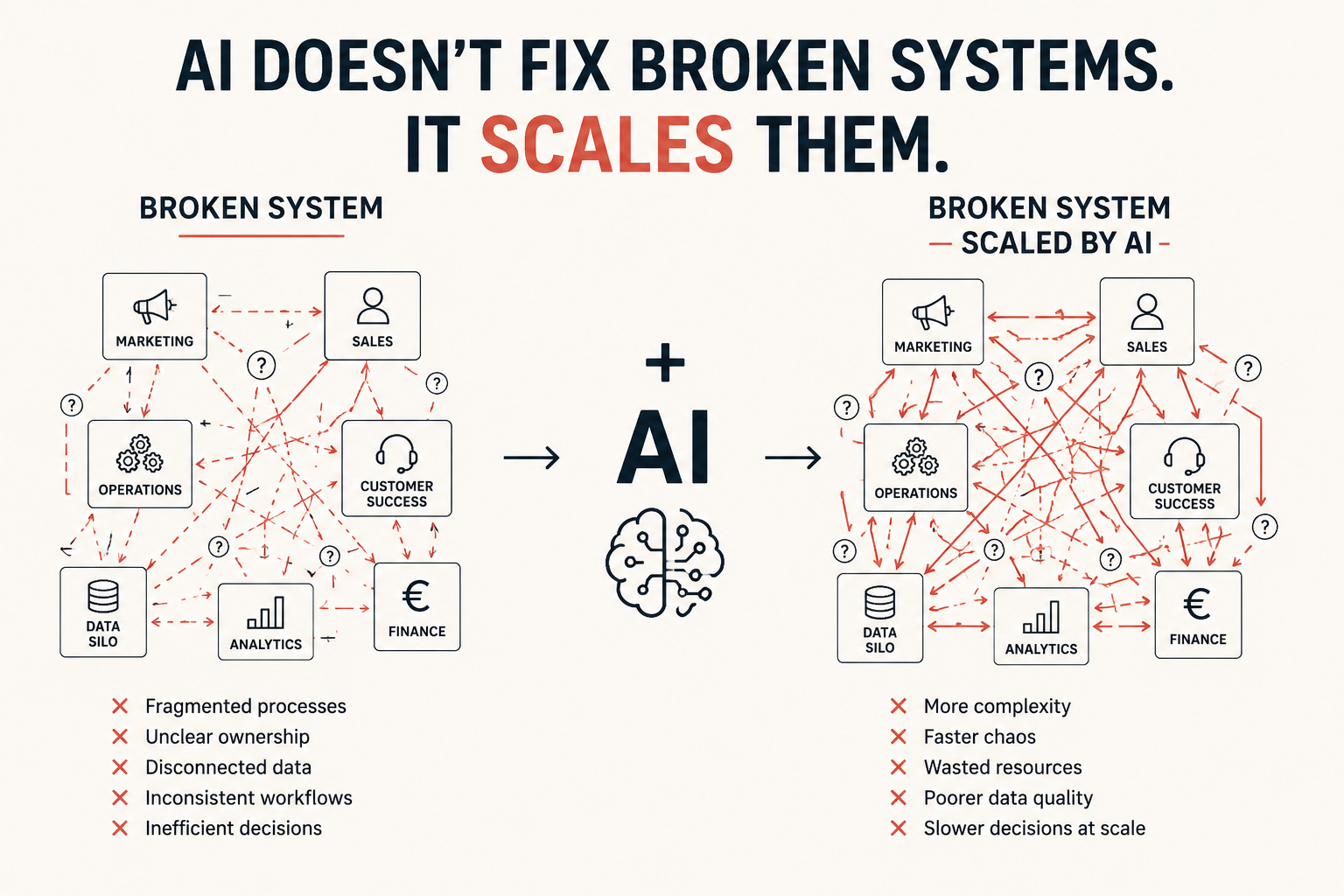
Many companies I work with don’t have an AI problem. They have an operations problem they’re trying to solve with AI tools.
Over the last two years, I’ve watched organizations buy tools, experiment with copilots, generate content faster and announce “AI transformation” initiatives before their operational foundations were anywhere close to ready.
The bottleneck is rarely the technology. It’s the organizational reality underneath it: fragmented processes, unclear ownership, disconnected data, inconsistent workflows and the assumption that adding AI on top of operational chaos somehow creates efficiency.
In practice, what many organizations are building right now are AI islands.
One team experiments with ChatGPT. Marketing uses automation tools. Sales tests AI-generated outreach. Operations introduces another dashboard. Leadership discusses AI strategy. But very little of it is connected, and the result is often more complexity, not less.
Tool Adoption Is Not Transformation
What many companies underestimate is that operational transformation is fundamentally different from tool adoption.
Using AI to generate faster content is not transformation. Replacing one manual step in a workflow is not transformation. Adding another automation layer onto an already fragmented process is not transformation either.
Real transformation happens when organizations rethink how decisions, information and execution move through the business. And that requires uncomfortable questions.
I’ve been through this with SaaS companies and digital marketing teams. The questions that stall progress are almost always the same:
Who actually owns this process? Which data can we trust? Where are the real bottlenecks? Which decisions should stay human? What needs standardization before automation even makes sense?
These are not technology questions. They are organizational questions. And this is exactly where most initiatives slow down.
AI Accelerates What Already Exists
Operational reality is messy. Legacy structures exist for a reason. Teams work differently. Departments optimize for their own KPIs. Data quality is inconsistent. Leadership expectations are often disconnected from what execution teams can actually deliver.
AI accelerates whatever environment it is introduced into. If the underlying system is healthy, AI creates enormous leverage. If the system is fragmented, AI scales that fragmentation faster.
One of the biggest misconceptions right now is the belief that AI transformation is mainly about replacing human work. In many cases, the opposite is true. AI increases the importance of human judgment, operational thinking and cross-functional alignment.
Start With the System, Not the Tool
The companies that will benefit most from AI are probably not the ones using the most tools.
They are the ones who ask: what does our operation actually look like, and is it ready to be accelerated?
If the answer is unclear, that’s where to start. Not with the next tool.
Because successful AI adoption is less about selecting the right software. It’s about building the organizational clarity that makes any software work.
What does your operation look like before you add AI to it?
This article reflects how I think about marketing as one connected system. Read more about my approach →
Looking for marketing leadership that creates clarity?
I work as a Fractional CMO and marketing strategist with B2B SaaS, e-commerce and growth-stage companies across DACH and the Nordics. A 30-minute strategy call is usually enough to identify where the biggest opportunities are.
Book a Strategy Call →