
For nearly two decades, parts of the SEO industry have been searching for shortcuts. In the early days, the supposed formula was simple: repeat a keyword often enough and a page might rank. Later, the tactics became more sophisticated. Keyword density gave way to link schemes, ideal word counts, TF-IDF scores, templated content clusters and increasingly elaborate attempts to reverse-engineer the algorithm.
Today, the terminology has changed again. Businesses are being told they need GEO, AEO, LLMO, AI visibility monitoring, citation optimization and a growing list of technical adjustments designed to make brands appear in generative answers. The tools have evolved, but the underlying mindset often has not.
The same question keeps returning in a new form: What is the fastest way to gain visibility without doing the harder work of developing a relevant offer, a credible brand and a clear point of view?
Generative AI is accelerating this pattern because it has removed much of the friction from content production. A company can now generate articles, landing pages, newsletters, social posts and entire topic clusters in a fraction of the time they once required. This is useful, especially for smaller teams and specialists who can now communicate knowledge more efficiently. It also changes the economics of content.
When every business can produce almost unlimited amounts of competent-looking material, production itself stops being a meaningful competitive advantage. The scarce resource is no longer the ability to publish. It is the ability to contribute something worth finding, trusting and remembering.
The most important question is no longer how to produce more SEO content with AI. It is why a customer, a search engine or an AI system should consider the company a relevant and credible source in the first place.
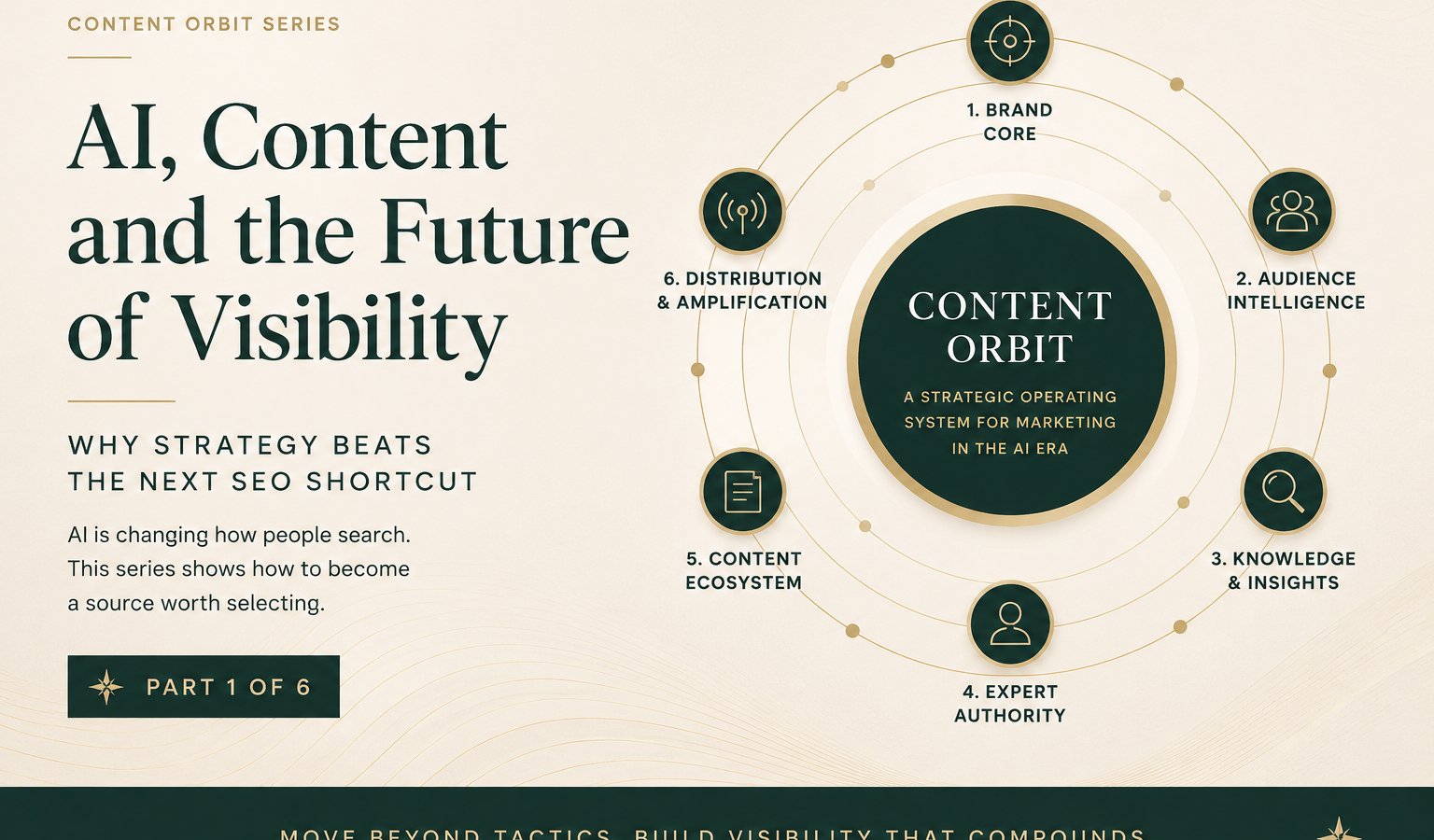
The answer leads back to the fundamentals of marketing: a strong offer, clear positioning, recognizable expertise, trust, reputation and a strategy that connects content, SEO, PR, distribution, sales and customer experience.
SEO was too often treated as a substitute for strategy
SEO itself was never the problem. Technical accessibility matters. Search intent matters. Clear information architecture, descriptive links, relevant terminology and useful page structures all help people and search engines find and understand information.
The problem begins when this work is presented as a substitute for strategic substance. In the early years of search optimization, pages were often written primarily for algorithms. Keywords were repeated in headlines, metadata, footers and awkward sentences that no person would naturally use. Google warned against keyword stuffing as early as 2006 and encouraged site owners to create unique, high-quality material instead.
The tactics later became less obvious, but the commercial promise remained similar. Companies were offered a formula: publish a certain number of words, use a specific term with sufficient frequency, acquire enough links or build pages around every variation of a keyword.
Some of these practices worked for a time. That is precisely why they became popular. Yet they also encouraged companies to avoid more difficult questions: What should the business be known for? Which problem does it understand better than its competitors? What evidence supports its claims? Why should customers trust it? How does its content reinforce its offer and its wider market position?
Rather than answering those questions, many organizations commissioned content because a keyword tool indicated search volume. Traffic became the objective, even when it had little connection to the company’s positioning, sales process or commercial priorities. This is where SEO turns from useful marketing infrastructure into a collection of disconnected tactics.
Google has spent years closing obvious loopholes
Google is not a neutral authority on information. It is a commercial company, and its results are neither perfectly objective nor consistently accurate. However, when examining which practices Google says it is trying to discourage, its own documentation remains the most relevant primary source.
The direction has been remarkably consistent. Panda was intended to reduce the visibility of thin or low-quality sites. Penguin targeted webspam and manipulative linking. The Helpful Content Update reinforced the idea that content should create a satisfying experience for visitors rather than exist mainly to attract search traffic. Google’s current spam policies also address scaled content abuse, regardless of whether pages were written by people, created through automation or produced with generative AI.
This does not prove that Google always identifies the best result. It shows that businesses relying on temporary loopholes are building their visibility on conditions they do not control. Each technique remains useful only for as long as the platform fails to detect, understand or devalue it.
GEO risks repeating SEO’s oldest mistake
The rapid growth of generative search has created legitimate new questions. Companies need to understand how AI systems discover information, select sources and represent brands. Visibility is no longer limited to a conventional list of blue links.
The problem is the speed with which these questions are being converted into another catalogue of supposed shortcuts. Do websites need an llms.txt file? Should every article contain an extensive FAQ? Should businesses create separate pages for every possible conversational query? Is prompt monitoring simply the new keyword tracking?
Some of these activities may be useful in particular circumstances. None of them should be confused with a complete strategy. Google’s official guidance states that its generative features continue to rely on existing ranking and quality systems, and that no special AI file or schema is required for eligibility.
Technical optimization can make valuable information accessible. It cannot create value that does not exist.
Replacing yesterday’s SEO tricks with tomorrow’s GEO tricks would not represent strategic progress. It would be the same dependency on platform mechanics, expressed through a newer vocabulary.
AI-generated content is not the real dividing line
A considerable amount of discussion still focuses on whether Google can identify AI-generated writing and whether such content will be penalized. This is the wrong distinction.
A human writer can produce a shallow article that merely paraphrases the first page of search results. An experienced specialist can use AI to organize original research, analyse interviews, structure proprietary data or make complex knowledge more accessible. The involvement of AI does not determine the value of the finished work.
The meaningful divide is between commodity information and original contribution. That contribution may come from first-party data, long-term customer experience, documented experiments, specialist judgement, proprietary methods, original research or a distinctive interpretation of developments in the market.
AI can help a company express its expertise. It cannot manufacture expertise that the organization does not possess. When businesses use AI to reproduce familiar information more quickly, they automate their own interchangeability. When they use it to extract, structure and distribute knowledge that is genuinely theirs, AI becomes a strategic amplifier.
Businesses need a knowledge system, not a content machine
Telling companies to share their thoughts is not enough. Opinions are easy to generate, and volume is no longer a reliable indicator of authority. Companies need a deliberate system for identifying, developing and distributing what they know.
That knowledge is often already present inside the organization, but it remains fragmented across sales calls, project documentation, customer support, internal presentations, research, product teams and the experience of individual specialists.
A useful content strategy turns those scattered assets into a coherent body of evidence and insight. This may include recurring patterns from customer projects, proprietary frameworks, internal benchmarks, original datasets, documented decisions, failures and their consequences, interviews with experts, research findings and practical criteria for evaluating different options.
The model should not be a content factory that begins with a keyword and ends with a published article. It should begin with a strategic question, connect it to real knowledge and decide how that knowledge can create value across the customer journey.
Blogs are not dead. Weak content systems are.
Claims that blogs no longer work often confuse the publishing format with the quality of the underlying strategy. Google does not inherently devalue an article because it appears under a blog directory. What matters is whether the page is accessible, useful, connected to related information and relevant to the person searching.
Many corporate blogs fail because they become chronological archives. Old posts remain untouched, several articles compete for the same topic, internal linking is inconsistent and the subjects have little connection to the company’s actual expertise or commercial offer.
That is not evidence that blogs are obsolete. It is evidence that publishing without architecture produces clutter. A strong content ecosystem can include durable pillar pages, focused articles, case studies, service pages, research, author profiles and practical resources. These formats should reinforce one another rather than exist as isolated assets.
Whether a company calls this environment a blog, magazine, academy, resource centre or knowledge hub is secondary. The structure, maintenance and strategic coherence matter far more than the label.
SEO belongs inside an integrated marketing strategy
SEO remains an important discipline. Websites still need to be crawlable, indexable and understandable. Information architecture, internal links, page experience and clear content continue to influence discoverability in traditional and generative search.
Yet SEO cannot determine what a company should stand for. It cannot create a relevant offer, generate proprietary knowledge or build customer trust in isolation. Companies therefore do not need an SEO strategy that sits separately from brand, PR, content, product marketing, sales and customer experience.
They need an integrated marketing strategy in which SEO performs a clearly defined function. That strategy connects positioning and offer, expertise and evidence, discoverability and distribution, and trust and business impact.
The objective is not maximum visibility. It is meaningful visibility.
Back to the fundamentals
The future of content looks highly technological. Strategically, it represents a return to the fundamentals. Marketing exists to understand problems, create orientation, communicate meaningful differences, build trust and help people make decisions.
SEO makes that value discoverable. AI makes it easier to analyse, produce, adapt and distribute. Neither can compensate for the absence of relevance.
The businesses that remain visible over the coming years will not necessarily be the ones publishing the greatest volume. They will be the ones that connect their brand, offer, expertise, reputation, technology and distribution into a coherent system.
Businesses do not need another shortcut. They need a strategy that determines what they want to be found for, remembered for, cited for and recommended for.
Companies with that strategy can use SEO and AI as amplifiers. Companies without it will simply automate their own interchangeability.
Sources
- Google Search Essentials: Spam policies
- Google Search Central: Creating helpful, reliable, people-first content
- Google Search Central: AI features and your website
- Google Search Central: AI optimization guidance
- Google Search Central: Guidance about generative AI content
- Google Search Central: Links best practices
This article is part of the Content Orbit series. AI, Content and the Future of Visibility
- AI Makes Content a Commodity ✓
- The End of SEO Shortcuts
- GEO Is Repeating SEO’s Oldest Mistake
- AI Content Is Not the Problem
- Blogs Are Not Dead
- Why Strategy Beats SEO Tactics
This article reflects how I think about marketing as one connected system. Read more about my approach →
Looking for marketing leadership that creates clarity?
I work as a Fractional CMO and marketing strategist with B2B SaaS, e-commerce and growth-stage companies across DACH and the Nordics. A 30-minute strategy call is usually enough to identify where the biggest opportunities are.
Book a Strategy Call →