
Over the past year I’ve started noticing a pattern in the B2B SaaS hiring market.
Not in trend reports or LinkedIn thought pieces, but in actual job postings. A quiet pattern emerging across B2B SaaS companies – particularly the lean, product-led kind. They’re not looking for another campaign manager. They’re not hiring a CMO. They’re looking for someone they struggle to name, but whose job description tends to read something like this: make the growth engine run.
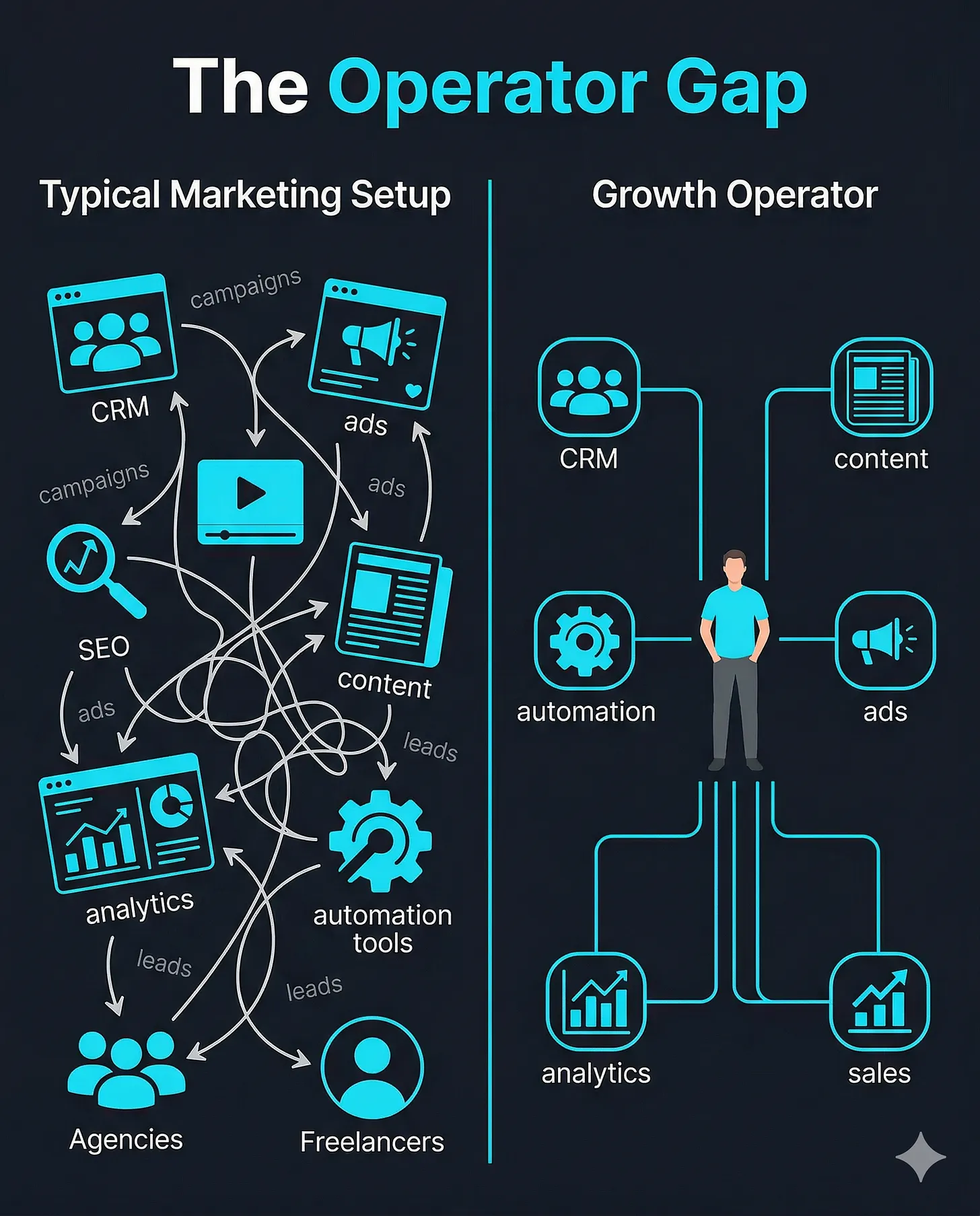
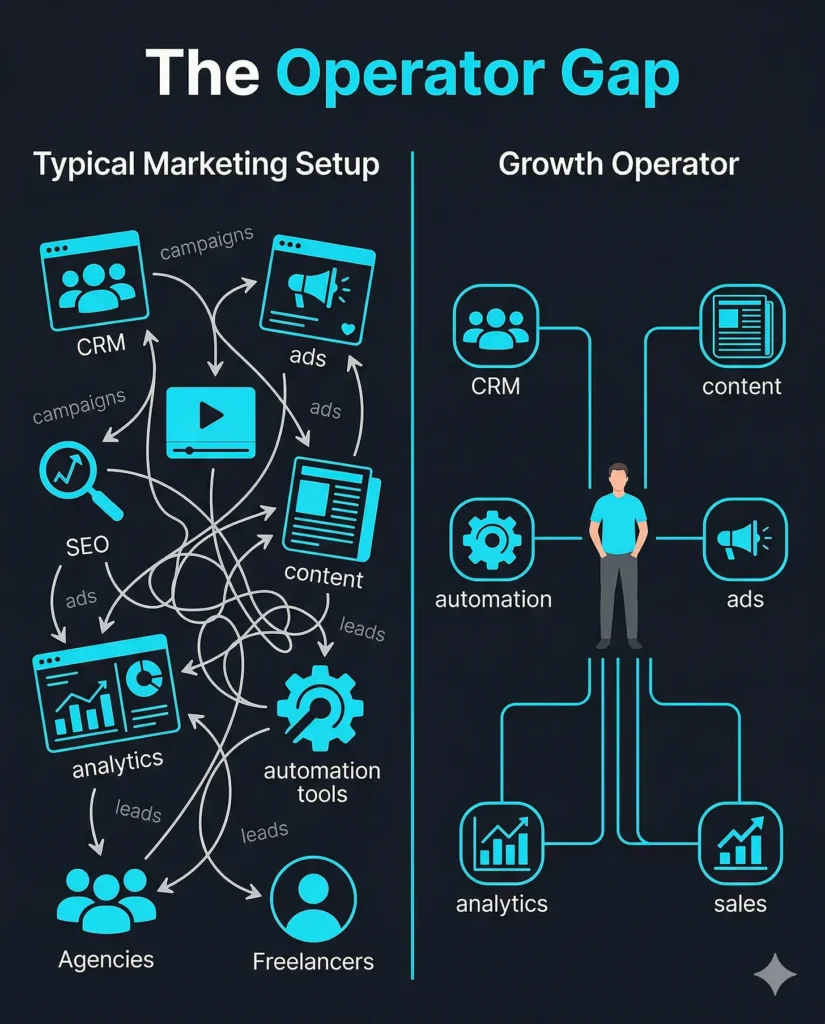
CRM structure and hygiene. Lifecycle automation. Funnel analytics. Coordinating a small constellation of external specialists. Weekly rhythm with the CEO. Turning data signals into concrete next actions. Not doing everything personally – but making sure nothing falls through the cracks.
I find this pattern genuinely interesting. And not just because it maps closely to how I work.
The gap that’s been hiding in plain sight
Many mid-sized and smaller B2B SaaS companies have, by now, assembled the pieces. A CRM. A marketing automation tool. An agency for SEO, maybe a freelancer for ads, someone handling content. The toolstack is there. The activity is happening.
And yet – conversion is murky. The nurture sequences haven’t been touched in six months. Ad spend doesn’t trace cleanly to pipeline. The CRM is a graveyard of leads no one followed up on. External contributors are producing work, but none of it quite connects.
This is what I’d call the operator gap.
It’s not a budget problem. It’s not a talent problem in the traditional sense. It’s a coordination and systems problem. Someone needs to hold the thread – to see the funnel as a whole, spot where it’s leaking, and make sure the people and tools involved are actually pulling in the same direction.
That someone isn’t the campaign manager. It isn’t the performance specialist. It’s a different profile entirely.
Three reasons this role is emerging now
1. AI has accelerated execution – but not judgment. With the right tools, teams can produce more content, run more experiments, and analyze more data than ever before. What AI doesn’t provide is someone who decides what matters, sets the priorities, and ensures that faster execution is pointed at the right things. Operational intelligence – the ability to read a system, find the bottleneck, and coordinate action – is becoming more valuable, not less.
2. Lean structures demand generalists with depth. Small and mid-sized companies can’t afford a Head of Demand Gen, a Marketing Ops Manager, and a CRM specialist all at once. What they need is someone who can hold these functions together pragmatically – not a master of each, but experienced enough to steer specialists, ask the right questions, and keep the whole system coherent.
3. Founders want to see what marketing actually produces. B2B buying cycles – especially in technical or niche SaaS – are long and multi-touch. Leadership has grown impatient with vanity metrics and wants to see the line between activity and revenue. That requires someone who understands what’s worth measuring, builds the right data foundation, and translates observations into decisions. Better dashboards alone don’t do that. A thinking operator does.
What makes this profile distinct
The most telling phrase I keep seeing in these postings is some variation of: success means making sure the machine runs, not doing everything yourself.
That’s a fundamentally different logic from most marketing roles.
It’s not about writing the best ad or building the perfect email template. It’s about knowing whether the right message is reaching the right segment at the right moment – and if not, diagnosing why and fixing it. It’s about running a clean weekly operating rhythm: what moved, what’s stuck, what needs to change. It’s about being the connective tissue between tools, people, and priorities.
The people who thrive in this kind of role tend to share a few traits. They find satisfaction in clarity emerging from noise. They notice bottlenecks before anyone names them. They communicate in a way that moves things forward rather than just documenting them. And they’re comfortable with ambiguity – not paralyzed by it, but energized by the problem-solving it requires.
Where I come in
I’ve spent years working at exactly this intersection – B2B SaaS, performance marketing, CRM and lifecycle operations, funnel analytics, and training others to think systemically about digital growth. What I’ve always found most satisfying isn’t the launch of a single campaign. It’s the quieter work of making the system function.
Not the glamour of a big campaign launch. The quiet, methodical work of making a funnel actually function. The satisfaction of a nurture flow that converts again because someone fixed the segmentation. The conversation with a founder where you finally trace why trial starts and pipeline aren’t moving together.
I’m not a traditional marketing manager who plans campaigns and reports upward. I’m someone who works in systems – with the goal of making them better, more measurable, and more connected to outcomes.
What I find meaningful about this emerging role type is that it finally has language. For a long time, this kind of work existed everywhere but was rarely named properly. “Marketing ops” sounded too administrative. “Growth hacker” sounded too chaotic. “Consultant” didn’t capture the operational ownership involved.
The operator – someone who understands strategy but lives in execution, who coordinates across tools and people, who makes the machine run – that profile is starting to get recognized for what it is.
What this means
For companies: if your growth engine isn’t producing what you expect, ask yourself whether it’s a resource problem or a coordination problem. Often it’s the second. One person who understands systems, sets priorities, and steers external resources well can unlock more than another agency retainer.
For professionals with similar profiles: these roles are rare partly because they’re hard to label. But the underlying skillset – thinking in systems, acting pragmatically, communicating in ways that drive decisions – is exactly what capital-efficient, product-led companies need right now.
It’s worth naming clearly.
This article reflects how I think about marketing as one connected system. Read more about my approach →
Looking for marketing leadership that creates clarity?
I work as a Fractional CMO and marketing strategist with B2B SaaS, e-commerce and growth-stage companies across DACH and the Nordics. A 30-minute strategy call is usually enough to identify where the biggest opportunities are.
Book a Strategy Call →