
“Our competitors have 40,000 followers. We have 8,000. We need to catch up.”
I hear some version of this in almost every marketing discussion. It sounds like analysis. It feels like strategy. But it contains at least two significant thinking errors at once.
Not just because follower counts say less about actual business impact than most people assume. But because using competitor follower counts as a benchmark adds another layer of flawed logic: it assumes your competitor is heading in the right direction. That assumption is rarely examined.
The Benchmark Trap: Why Comparing Follower Counts Structurally Misleads
When companies compare their follower count to a competitor’s, they’re measuring success against a number they cannot control and cannot interpret without context.
Equal follower counts do not produce equal results. An account with 10,000 followers in a tight B2B niche with high purchase intent generates different business outcomes than an account with 10,000 mixed consumers who have no clear buying motivation. The number is the same. The relevance is not.
There’s also a lot you simply don’t know about how your competitor built that number. Whether it grew organically or through paid followers, giveaways, or broad-reach campaigns. Whether that account actually contributes to their customer journey or mostly collects likes. Whether the strategy behind it is working at all.
Chasing that number means optimizing for a metric whose meaning you don’t know, at a company whose strategy you don’t understand. That’s not competitive intelligence. It’s guesswork dressed up as benchmarking.
What Follower Counts Actually Measure (and What They Don’t)
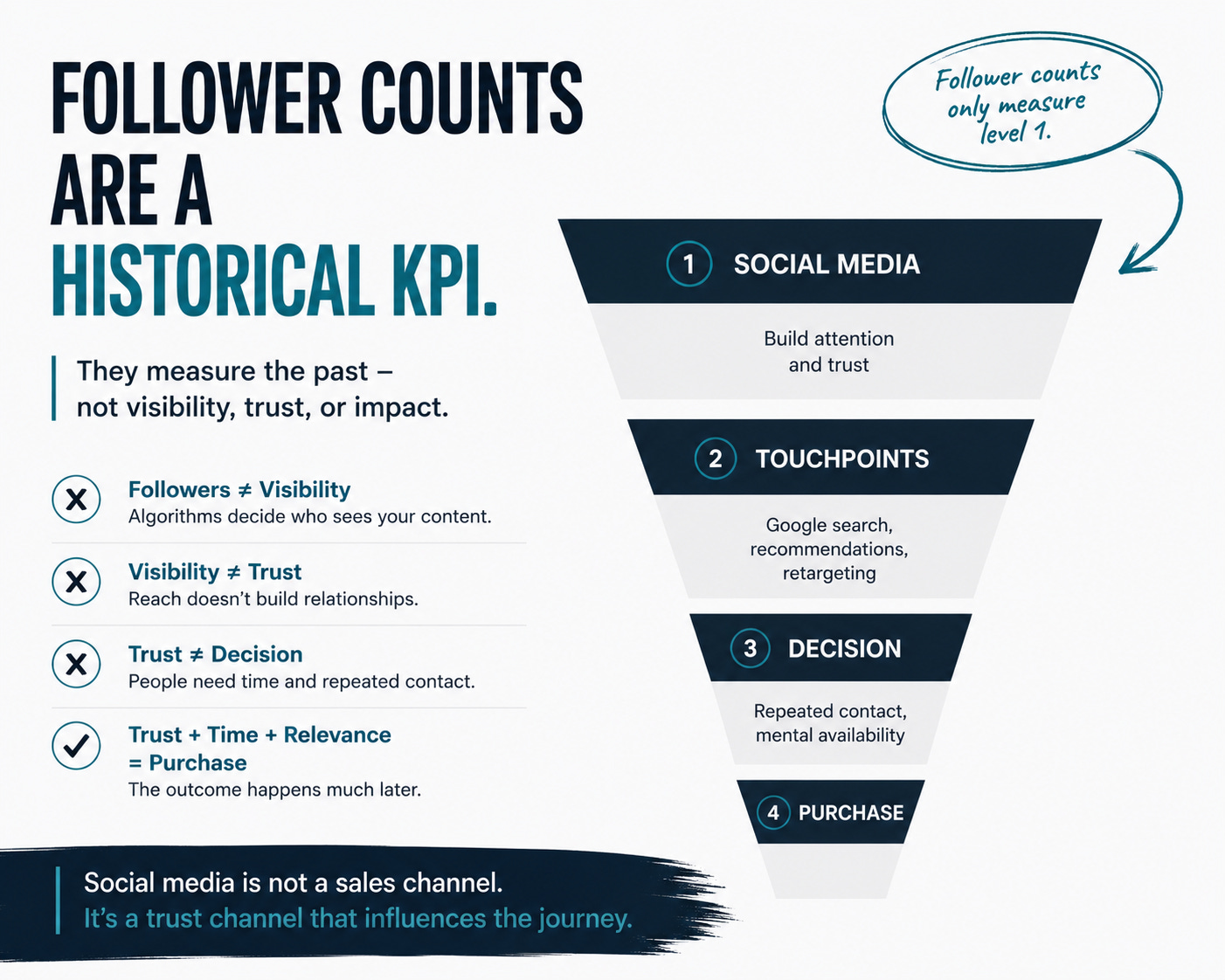
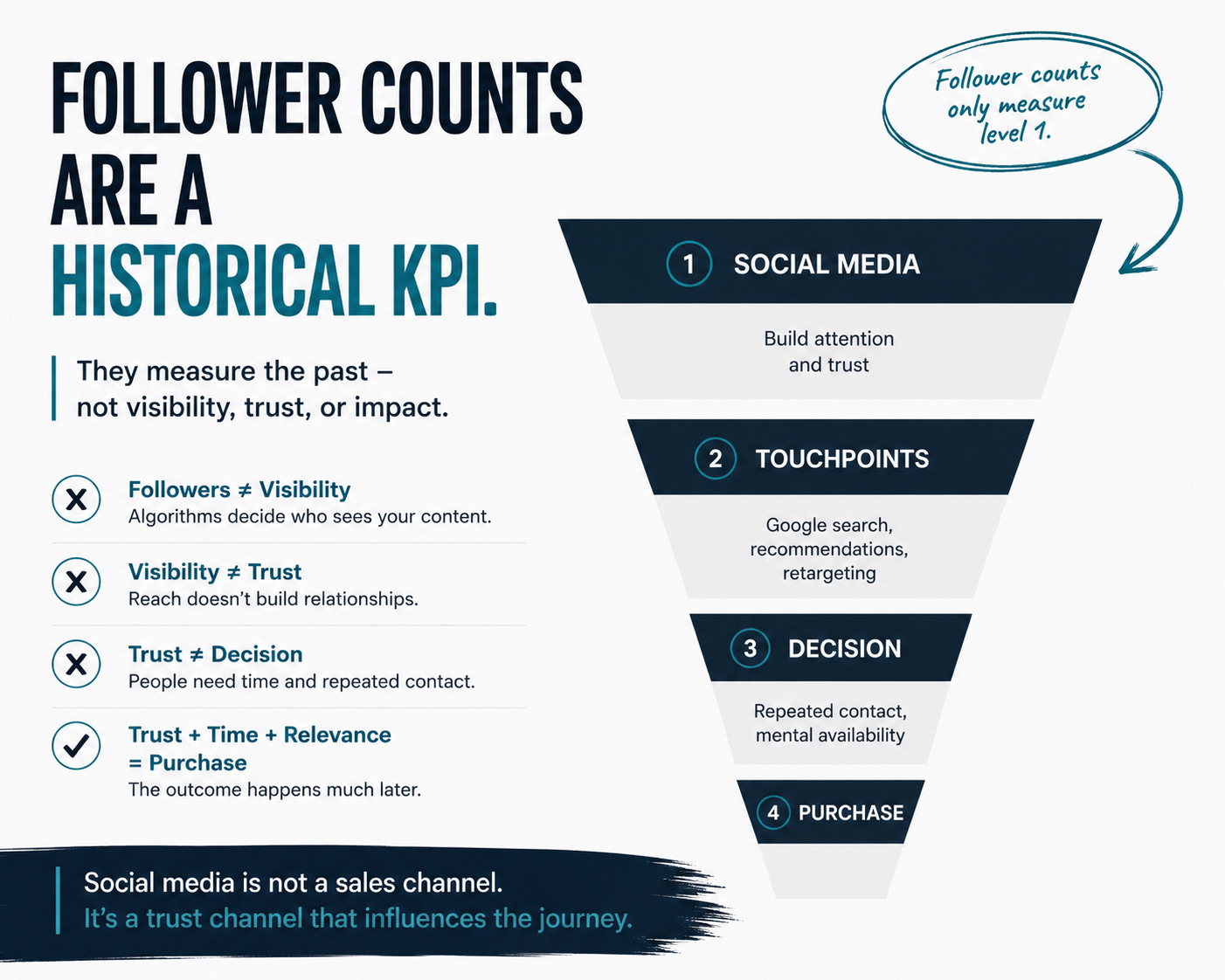
Follower counts are not a performance indicator. They’re an inventory indicator. They show how many people decided to follow an account at some point in the past. Not whether those people are still active. Not whether they’re likely to buy. Not whether they belong to your target audience.
Algorithms on every major platform now operate largely independently of follower numbers. Content gets shown to people based on relevance signals, watch time, engagement patterns, and search behavior, regardless of whether they follow the account. That means reach is increasingly a function of content quality and platform logic, not follower count.
At the same time, a large share of existing followers on most accounts are permanently inactive. Organic reach on established platforms like Instagram or LinkedIn regularly sits below five percent of total followers. What remains is a number that signals size to the outside world but has little practical value for internal decision-making.
Where Social Media Actually Fits in the Marketing Mix
Social media is not a primary sales channel. It structurally never was, even if cheap ad formats briefly made it look that way.
It’s an attention and trust channel. Its function in the marketing mix is to create visibility, communicate positioning, and build psychological presence, meaning: to increase the likelihood that a potential customer thinks of you when a buying moment arrives.
The actual purchase usually happens somewhere else: through Google, direct referrals, retargeting campaigns, or after repeated contact across multiple touchpoints. Social media shapes these processes significantly, but rarely directly and often with a time delay. That makes the impact harder to measure. It does not make it less real.
This distinction has practical consequences. If social media primarily builds attention and trust, the relevant question is not how many followers an account has. It’s whether the account is reaching the right people and whether it’s systematically building their trust over time.
Better Questions to Ask Instead
Rather than comparing follower counts with competitors, these questions give you more actionable information:
• Are people actively searching for us? Rising branded search volume on Google is a more reliable signal of growing awareness than follower counts.
• Are people saving or sharing our content? Saves and shares indicate genuine interest and drive organic reach far more effectively than passive likes.
• Are we generating qualified conversations or inquiries? An account that consistently produces concrete leads creates business impact regardless of its size.
• Is social media supporting other channels? Are conversion rates higher among users who had prior social media contact? Good attribution can answer this.
• Is perception of our brand shifting? Qualitative signals like comment quality, the tone of mentions, or feedback in sales conversations reveal things no number captures.
These questions are harder to answer than a follower comparison. They require more context and more interpretation. But they lead to better decisions, and they keep you from optimizing for the wrong thing.
What This Means in Practice
Companies that measure social media by follower counts are still navigating with metrics from a platform era that no longer exists. The algorithms changed. The organic reach changed. The way buying decisions are made changed. The benchmarks haven’t caught up.
The question that matters is not whether you have more followers than your competitor. It’s whether social media is doing its actual job: reaching the right people, building trust, and supporting the buying process.
You don’t need 40,000 followers for that. You need clarity on what social media is supposed to deliver in your specific marketing mix, and which signals tell you whether it’s delivering it.
This article reflects how I think about marketing as one connected system. Read more about my approach →
Looking for marketing leadership that creates clarity?
I work as a Fractional CMO and marketing strategist with B2B SaaS, e-commerce and growth-stage companies across DACH and the Nordics. A 30-minute strategy call is usually enough to identify where the biggest opportunities are.
Book a Strategy Call →