
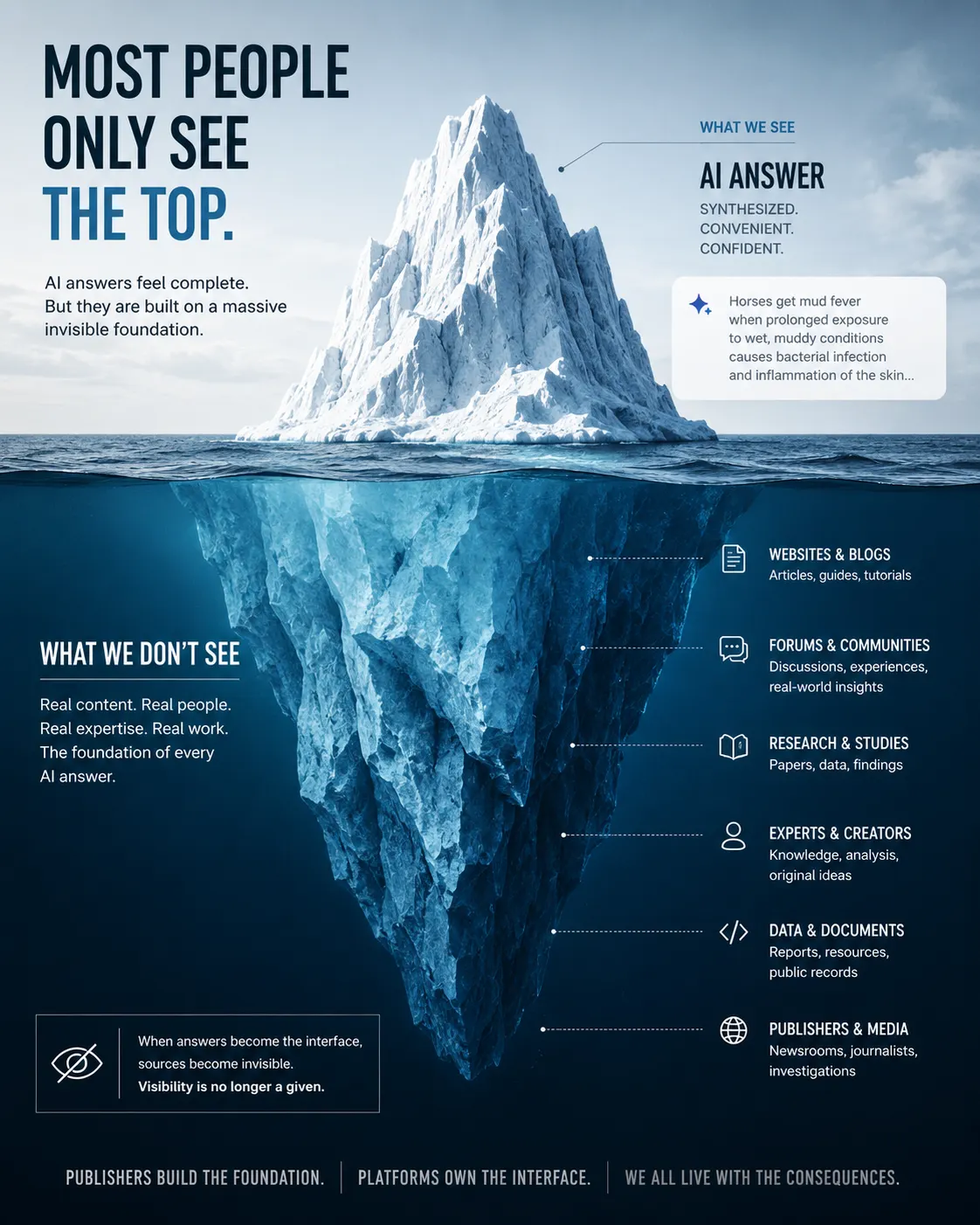
Who Owns Visibility on the Internet
On June 3, 2026, the UK’s Competition and Markets Authority made something happen that has never existed before. Publishers in the United Kingdom can now keep their content out of Google’s AI Overviews and AI Mode without disappearing from standard search results. Google must also provide clearer attribution and allow publishers to opt out of having their content used for AI model training. The CMA calls it a world-first requirement.
On the surface, this looks like a technical regulatory decision. It is not. It is a confession of power. Regulators do not create opt-out rights unless a company has become powerful enough that participation is no longer a genuine choice.
What This Decision Really Means
Until now, publishers faced a binary choice: allow your content to be used for AI summaries, or risk losing visibility. The new rules create a third option, but they do not solve the underlying problem. Publishers who opt out may protect their intellectual property, but they also risk becoming less visible as Google’s products become increasingly AI-driven. Publishers who stay opted in continue feeding a system that is already reducing referral traffic while capturing more of the user journey itself. The opt-out right is progress, but it is not a solution. Google still controls more than 90 percent of UK search queries and increasingly decides whether a click is necessary at all.
The model is simple: publishers supply the substance, Google supplies the answer, the user stays on the platform.
The Shift Is Bigger Than SEO
Much of the current debate revolves around SEO, GEO, rankings, and traffic. I increasingly think that misses the point. The real shift is not happening in optimisation, it is happening in the interface. For years, Google’s role was relatively straightforward, connecting users with information and acting as a navigation layer between people and websites. Today it is becoming something else: an answer layer. And that changes what it means to publish anything at all.
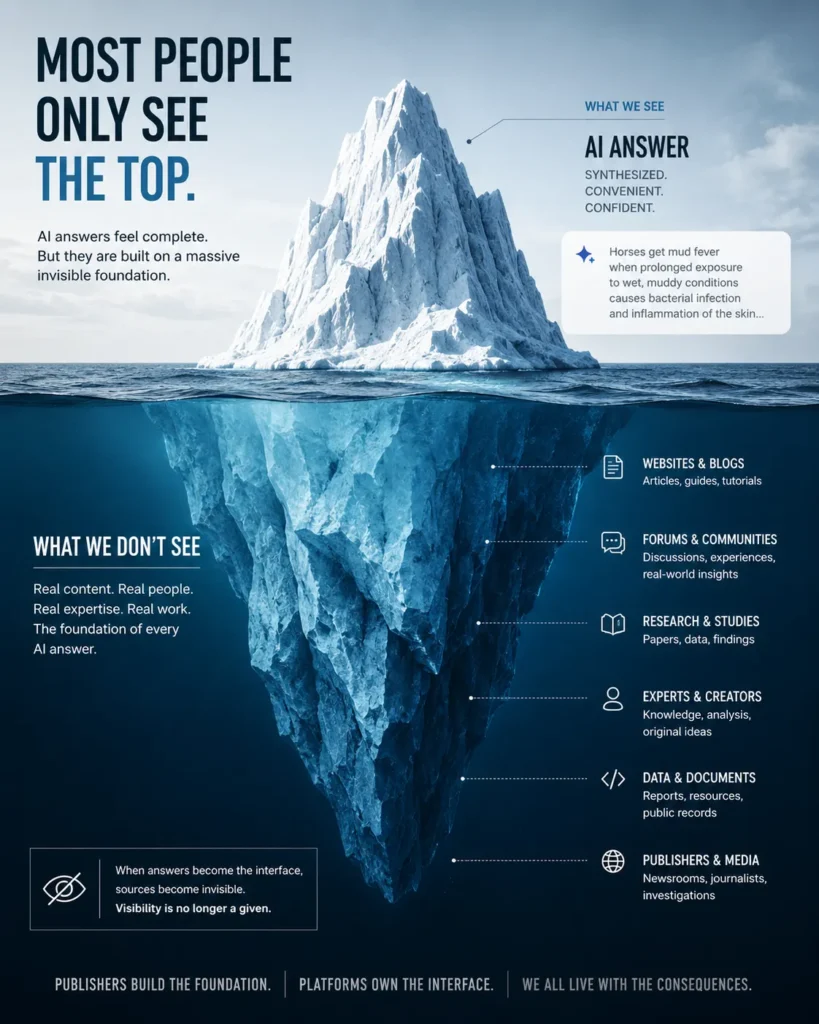
A user searching for how to treat mud fever in horses once had to visit veterinary websites, blogs, manufacturer pages, research papers, and discussion forums. The sources were the destination. Today, AI Overviews can synthesise those same sources into a single answer before the first click ever happens. The sources still exist. They simply disappear behind the interface.
The Real Question Goes Deeper
Traffic losses and publisher rights are finally receiving attention. What receives far less attention is the question underneath: what happens to our relationship with knowledge when answers become more important than sources?
Historically, the origin of information was visible. You could see who made a claim, compare perspectives, and evaluate competing sources. That system was imperfect. Rankings could be manipulated, and large platforms dominated attention even then. But one thing remained visible: information came from somewhere. Generative search systems change exactly that. The answer appears directly, fluent, confident, coherent, and plausible. That is precisely their strength, and potentially their greatest risk, because people frequently confuse linguistic confidence with factual certainty.
LLMs do not generate truth. They generate statistically plausible language. That does not make them useless, quite the opposite. I use AI every day and consider it one of the most powerful tools created in my professional lifetime. But we should not confuse usefulness with authority. Language models do not verify truth, they predict probability. And the better these systems become, the harder that distinction becomes for users to see.
Who Controls the Interface?
The CMA decision is an important regulatory milestone. It acknowledges that the relationship between publishers and platforms has fundamentally changed. Whether these new controls ultimately provide meaningful leverage or simply create an opt-out button with limited economic impact remains to be seen.
But the larger question remains unanswered. Who controls visibility when answers replace destinations? Who controls trust when information arrives detached from its origin? The debate around AI search is often framed as a dispute about traffic. I increasingly think it is a dispute about something much larger.
For centuries, knowledge was tied to visible sources. We knew who was speaking. We knew where information came from. Generative systems separate answers from their origins. And once that happens at scale, visibility is no longer the only thing being redistributed. Trust is.
The real risk of AI search is not that machines will give us the wrong answers. It is that people may stop asking where the answers came from.
This article reflects how I think about marketing as one connected system. Read more about my approach →
Looking for marketing leadership that creates clarity?
I work as a Fractional CMO and marketing strategist with B2B SaaS, e-commerce and growth-stage companies across DACH and the Nordics. A 30-minute strategy call is usually enough to identify where the biggest opportunities are.
Book a Strategy Call →