
If you work in SEO, content, or AI search right now, you keep running into two seemingly contradictory statements.
On LinkedIn, the message is constant: SEO is dead. GEO is the future. AI search changes everything.
At the same time, Google itself has published an official “AI Optimization Guide” explaining something surprisingly unspectacular: helpful content, clear structure, technical quality, and expertise remain the decisive factors.
That sounds like a contradiction. It isn’t.
Google is communicating continuity in optimization while something more fundamental is changing at the same time: the role of the open web itself.
The Google Guide Is More Honest Than the GEO Bubble
Sascha Pallenberg made a point in his podcast episode „Best of Google I/O 2026 – Das Ende des offenen Webs!” that is almost entirely missing from the current SEO debate. His central observation: Google is evolving from a classical search engine into a dialogic interface. The new Search Box, which he describes as “the biggest upgrade in 25 years,” marks this shift not as an announcement but as a completed step.
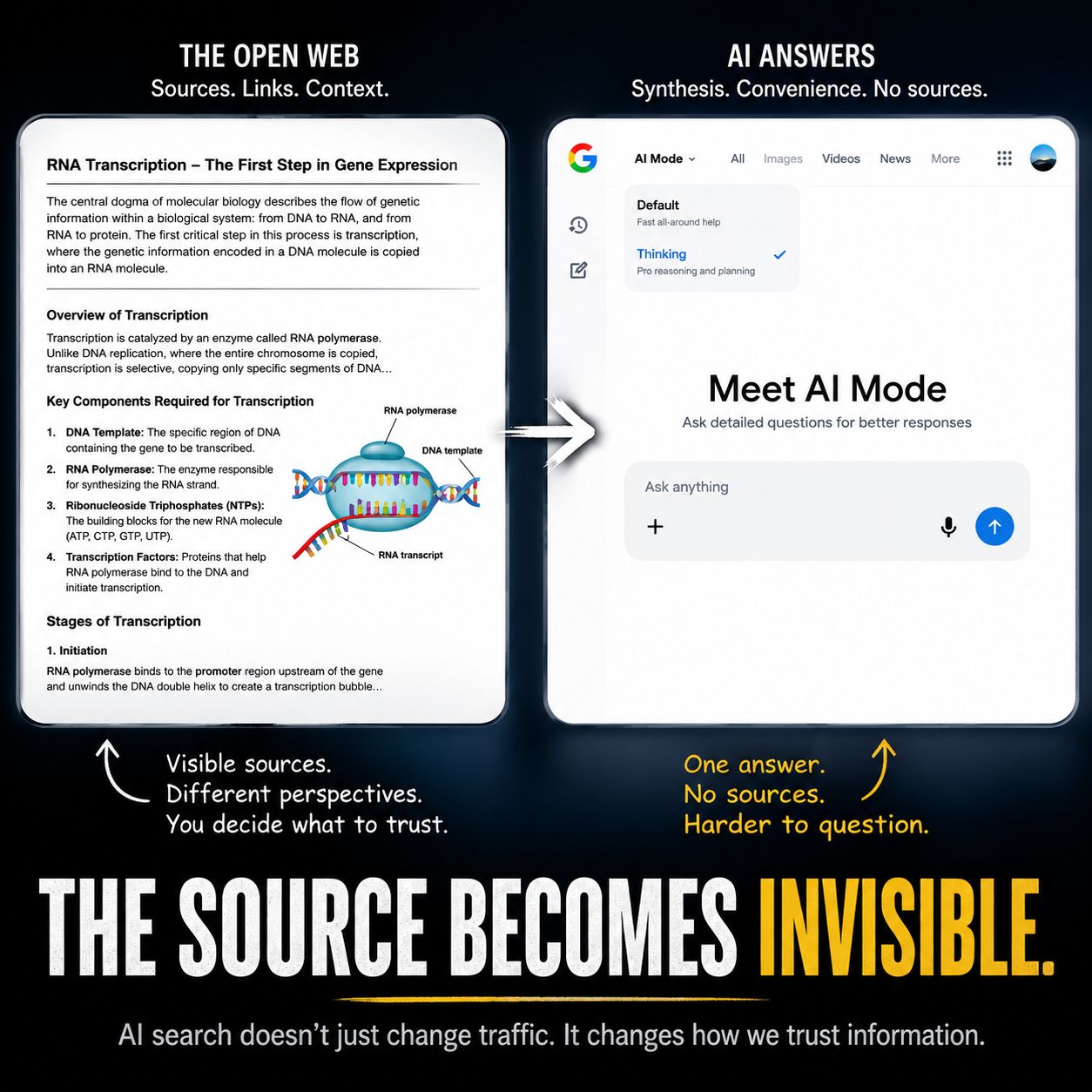
Google is no longer a gateway to sources. Google is becoming the answer surface itself.
That is exactly why the official Google AI Optimization Guide is worth reading carefully. Because Google does not claim that entirely new rules suddenly apply. The guide says, in essence:
There are no GEO hacks. AI search requires no special optimization. Good content remains the foundation. Structure and clarity help machines understand.
The fundamentals of SEO remain largely intact. And that is precisely why much of the current GEO debate is simply marketing. Many are selling a revolution that Google itself has not declared.
But there is a critical mistake in this thinking: the continuity applies to content optimization. Not to the economic role of websites.
And that is exactly where the real break is happening.
Content Is No Longer Just Found. It Is Extracted.
Pallenberg describes Generative UI in Google Search as a “possible final nail in the coffin for the open web.” That is a strong statement. But it points to something real.
For many years, the open web operated on a simple principle: search engines send users to websites. Websites monetize attention.
Generative search systems attack this model directly.
A concrete example: someone used to search “how do you treat scratches on a horse?” The search engine returned specialist articles, blog posts, manufacturer pages, user experiences. The user clicked through multiple sources.
Today, an AI Overview potentially delivers causes, symptoms, treatment steps, prevention measures, and product recommendations in a single synthesized answer. The original sources still exist. But they increasingly disappear behind the generated summary.
The same dynamic plays out in B2B. Ask ChatGPT which CRM suits a small SaaS company and you often receive a condensed market analysis, drawn from blog posts, Reddit discussions, comparison sites, and product pages. The models read the open web. But the user never leaves the interface.
That is why the conversation about rankings alone no longer covers enough ground. The decisive question is no longer “where do I rank?” It is: “am I even part of the generated answer at all?”
The Bigger Problem Is Not an SEO Problem
The economic consequences of this shift are at least starting to be discussed. A different change is receiving far less attention, and it may be considerably more serious.
AI search is not only changing how people find information. It is changing how people perceive truth.
Search used to consist visibly of sources. People saw different websites, different perspectives, and had to judge for themselves which source to trust. That system was never neutral or perfect. Rankings could be manipulated, large platforms dominated attention. But the structure made something visible: information comes from different origins.
Generative search systems change exactly that.
The answer appears directly: fluently written, linguistically confident, plausible and coherent. This creates an impression of objectivity, even when the underlying information is outdated, incomplete, or simply misinterpreted.
The real risk is not only incorrect answers. It is that people increasingly trust the quality of the phrasing rather than the sources behind it.
LLMs do not generate truth. They generate statistically plausible language. That is a fundamental difference. And it becomes more invisible to most users every day.
What This Means for Companies
Pallenberg describes Google Glasses with Gemini and the new 24/7 AI agent Gemini Spark as the next stage of this development: AI no longer as a tool you invoke, but as a permanent layer between humans and information.
If that holds, the requirements for brand building shift fundamentally as well.
Many companies still measure primarily rankings, clicks, and impressions. But exactly these metrics lose explanatory power when decisions increasingly emerge inside generated interfaces, not in classical search results.
What matters more: brand authority, direct audience relationships, content that is genuinely worth citing, and presence on platforms where real discussions happen: Reddit, YouTube, specialist podcasts, newsletters, communities.
In a world of generative interfaces, being found is no longer enough. Brands need to become memorable before the search even begins.
Conclusion
SEO is not dying. But the open web is losing its role as the primary interface of the internet.
What is changing is not the optimization logic. It is the question of who controls the layer between humans and information going forward.
And the more convincing the generated answers sound, the fewer people will ask where they actually came from.
This article reflects how I think about marketing as one connected system. Read more about my approach →
Looking for marketing leadership that creates clarity?
I work as a Fractional CMO and marketing strategist with B2B SaaS, e-commerce and growth-stage companies across DACH and the Nordics. A 30-minute strategy call is usually enough to identify where the biggest opportunities are.
Book a Strategy Call →